
At 68 you have been told you need implants, and the quote was $23,500 for one arch. The real question is whether someone your age should spend that on teeth, and whether the implants will outlast the loan.
There is no upper age limit for dental implants, and the research says they work about as well at 75 as at 55. Around 93 to 96 percent of implants are still in place after 10 years. A full arch costs $14,000 to $32,000 in the US and $4,500 in Tbilisi, Georgia, with the same brands. Dentures cost less on day one but shrink the jawbone every year. Original Medicare pays nothing for any of it.
Table of Contents
ToggleAre you too old for dental implants?
No. Age by itself is not a reason to refuse implants. What matters is the bone in your jaw, the medicines you take, whether your diabetes is controlled, and whether you can keep the implants clean.
A 2025 systematic review pooled 27 studies and 3,892 implants in people aged 65 and older. Five-year survival was 96.8 percent in patients over 75 and 92.1 percent in the 65 to 75 group, and the authors called implants a reliable treatment for older adults, including those over 75 (Abou-Ayash et al., Clinical Oral Implants Research, 2025). An earlier review of patients over 65 found 91.2 percent survival at ten years, Srinivasan et al., 2016.
Are dental implants worth it at 65, 75 and 85?
At 65, yes for almost everyone who can afford them, because you will likely use them for two decades. At 75, usually yes, if you want to chew normally for the years you have. At 85, it depends on health and on whether a simpler fix would do.
An American who reaches 65 can expect another 19.5 years on average, per 2023 National Center for Health Statistics data. A $23,500 arch used for 19 years costs about $1,240 a year. The same arch in Tbilisi, $4,500 plus a $2,500 trip, costs about $370 a year, and even at 80 that beats relines, adhesive and a soft-food diet. People with loose lower dentures avoid steak and nuts, eat alone, and lose weight; at 82 implants can be the better call.
How long do dental implants last?
Most implants last the rest of your life. Across 18 prospective studies, 96.4 percent of implants were still in place after 10 years, and a stricter analysis that counted every patient lost to follow-up as a failure still gave 93.2 percent, Howe, Keys and Richards, Journal of Dentistry, 2019.
The same review found patients aged 65 and over had a higher loss rate, about 91.5 percent in the strict analysis. That is still nine in ten after a decade. And the titanium post in the bone lasts for decades, while the crown or bridge on top is a wear item, commonly renewed after 10 to 15 years.
Dental implants vs dentures: the 10-year picture
Dentures win on price in year one and lose on almost everything after that. Implants cost far more up front, but they hold the jawbone, chew like teeth, and are not remade every few years.
Once teeth are gone, the ridge keeps shrinking for as long as a denture rests on it. The classic 25-year study of denture wearers documented continuous loss, fastest in the first years and worst in the lower jaw, Tallgren, 1972. That is why a lower denture that fitted at 65 floats at 72. An implant loads the bone like a root, and the bone stays.
| Over 10 years | Full dentures | Implant arch (All-on-4) |
|---|---|---|
| Upfront cost, US | $1,500 to $3,600 a set (2026 average $1,953) | $14,000 to $32,000 per arch |
| Remakes and relines | Relines and usually one remake in a decade (the ACP sets no fixed interval) | Hygiene visits twice a year; bridge renewal around year 10 to 15 |
| Chewing | Soft diet common; lower plate moves | Fixed, chews most foods |
| Jawbone | Keeps shrinking under the plate | Preserved around the implants |
| Still working at year 10 | Usually on a second or third set | 93 to 96 percent of implants in place |
Dental implants pros and cons for an older patient
The advantages are that implants chew like teeth, keep the bone and need no adhesive. The disadvantages are cost, three to six months of healing, a small failure rate that rises a little with age, and daily cleaning for life.
- Pro: you eat what you like, in company.
- Pro: the jawbone and the shape of the lower face hold up, and there is no plate across the palate.
- Con: $14,000 to $32,000 an arch at home, and Medicare pays none of it.
- Con: roughly 1 implant in 15 to 20 fails within 10 years in older patients.
- Con: gum disease around implants is real, and stiff hands make cleaning harder; a water flosser helps.
Which medications matter: bisphosphonates and blood thinners
Two groups of drugs change the plan but rarely rule implants out. Osteoporosis drugs such as alendronate and denosumab carry a small risk of jaw bone necrosis after surgery. Blood thinners such as warfarin and apixaban raise bleeding, and the official advice is usually not to stop them.
On bone drugs, the 2022 AAOMS position paper on medication-related osteonecrosis of the jaw puts the risk for osteoporosis patients at less than 0.05 percent. It is higher with intravenous cancer doses and with denosumab. Tell the surgeon the drug, dose and years taken, and let the surgeon and the prescribing doctor decide together. Never stop denosumab on your own; stopping it raises the risk of spinal fractures.
On blood thinners, the American Dental Association states that warfarin and antiplatelet regimens should not be altered before dental procedures, and that the newer anticoagulants need no change before most dental interventions, implant placement included, ADA, updated September 2022. A stroke from stopping is worse than bleeding the dentist controls with stitches.
Medicare does not pay. What does?
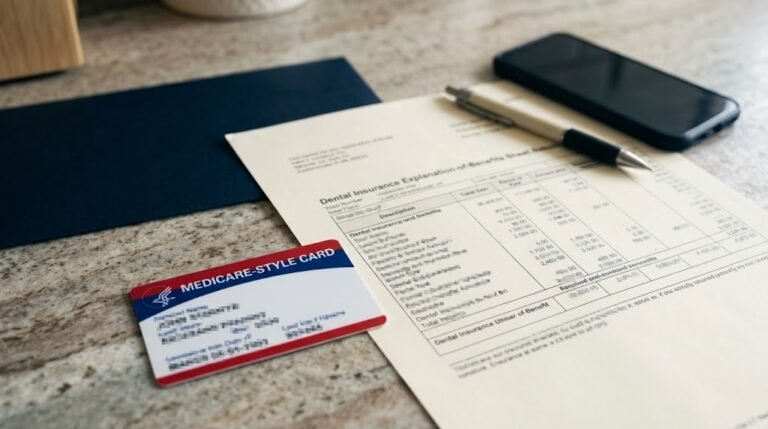
Original Medicare does not cover implants or dentures. The official page says that in most cases Medicare does not cover items like dentures and implants, and the narrow exceptions are hospital inpatient care and dental work tied to transplants, cancer treatment or dialysis, Medicare.gov.
Some Medicare Advantage plans include an implant benefit, but the annual cap is often $1,000 to $2,000, and dental insurance is similar. Adult Medicaid dental varies by state and almost never includes implants. The detail, including the IRS medical deduction, is in Does Medicare, Medicaid or dental insurance cover dental implants?.
What implants cost a senior in the US and in Tbilisi
A single implant with crown averages $4,500 in the US in 2026, from $3,759 in Alabama to $5,733 in California, and one All-on-4 arch averages $23,500 within a $14,000 to $32,000 range, Dental Implant Cost By State 2026. In Tbilisi the same arch is $4,500 fixed and all-inclusive; a bone graft, sinus lift or sedation is quoted in writing before travel.
| Treatment | US, 2026 | Tbilisi, fixed, all-inclusive |
|---|---|---|
| Single implant + zirconia crown | $3,759 to $5,733 (average $4,500) | from $730 (NTA®) or $1,450 (Straumann®) |
| All-on-4, one arch | $14,000 to $32,000 (typical $23,500) | from $4,500 |
| Both arches on All-on-4 | $28,000 to $64,000 (typical $47,000) | from $9,000 |
| Flights + 3 weeks hotel | $0 | about $2,500, plus one airfare for a companion |
| Both arches, all in | about $47,000 | about $11,500 |
A single implant does not justify the trip; saving $3,000 on one tooth and spending $2,500 to get there is a wash. The trip pays for a full arch, where the saving is $12,000 to $35,000.
Going abroad at 70: Mexico, Costa Rica or Georgia
Yes, it is safe to get dental implants in Mexico, Costa Rica or Georgia at 70 if you choose the clinic carefully, travel with someone and allow enough time. The cheapest place to get dental implants depends on where you live. Mexico wins on distance, Georgia on a fixed price for full-arch work.
What changes with age is the logistics: a companion, travel insurance that covers pre-existing conditions, and a written plan that says how many visits you will make. For a full arch, the implants heal before the final bridge is fitted, and your written plan says whether that happens within the stay or at a second short visit, and what is included.
| For an older traveler | Mexico (Los Algodones, Tijuana) | Costa Rica | Georgia (Tbilisi) |
|---|---|---|---|
| Single implant + crown | about $1,150 to $1,500 (Real Dental Costs, May 2026) | $850 to $2,000 (Real Dental Costs, Aug 2026) | $730 to $1,450, fixed |
| All-on-4, one arch | $6,000 to $11,000 (2026 city guide; Real Dental Costs) | $9,500 to $12,000, average $11,000 | $4,500, fixed |
| Getting there | Drive or short flight | Nonstop from many US hubs | One connection, a long travel day |
| Visits for a full arch | Often two trips | Often two trips | 2 to 3 weeks; plan states if a second visit is needed |
| Price fixed in writing before travel | Varies; grafts and sedation often extra | Varies by clinic | Yes, scan, guide and bridge included |
| If something fails | Redone free; you pay the return trip | Same | Same; implant passport lets any dentist service it |
For a full arch, the Georgian fixed price with Straumann® or Bredent® implants usually lands $2,000 to $6,000 below a Mexican or Costa Rican quote once grafts, sedation and the second trip are added.
What if an implant fails years later?
A failed implant is removed, the site heals for a few months, and in most cases a new one is placed. The usual dental implant problems years later are gum infection around the implant, overloading from grinding, a loose screw or a chipped bridge.
The early signs are bleeding when you brush around the implant, a bad taste, a loose bridge, or new pain on chewing. Any dentist can check. The implant passport records brand, size and parts, so any dentist can service it.
Frequently asked questions
Can an 80-year-old get dental implants?
Yes. The 2025 review above found 96.8 percent five-year survival in patients over 75. The surgeon checks bone volume on a 3D scan, diabetes control, the medication list, and whether you can clean the implants. A snap-on denture on two implants is often the sensible version at 80.
What dental implant problems show up years later?
Peri-implantitis, gum disease around the implant, is the main one and is driven by plaque and smoking. Others are a chipped crown, a loose abutment screw, or bone loss from grinding. Most are repairable. Twice-yearly cleanings, a water flosser and a night guard if you grind prevent most of them.
Does implant surgery hurt more when you are older?
No. The surgery is done under local anesthetic, sedation is available, and most patients describe the first two days as sore rather than painful, managed with acetaminophen or ibuprofen if your physician allows. Healing is a little slower after 70, so the final bridge waits until the bone has bonded.
Is All-on-4 better than a snap-on denture for a senior?
All-on-4 is fixed, chews harder and never comes out, but costs more and needs four to six implants. A snap-on denture on two implants is removable, cheaper, easier to clean with stiff hands, and stops the lower plate moving. For many patients over 80 it is the better trade.
Does Medicare Advantage pay for dental implants?
Some plans include an implant benefit, but read the summary of benefits, because many cover only cleanings and basic work, and the annual cap is often $1,000 to $2,000. Original Medicare pays nothing. The full breakdown is in our insurance guide.
Can I fly home a few days after implant surgery?
For single implants, usually yes within a few days once bleeding has stopped and the stitches are checked. For a full arch, stay the full two to three weeks so the surgeon sees you before you leave. Drink water on the flight, skip alcohol, and walk the aisle every hour.
The short version
- Age is not a barrier. Implants survive at 93 to 96 percent after ten years, and the over-75s do as well as anyone.
- Over ten years implants beat dentures on chewing, bone and remakes. A snap-on denture on two implants is the honest middle option at 80 plus.
- One arch is $14,000 to $32,000 at home and $4,500 fixed in Tbilisi. Medicare pays nothing either way.
Send a 3D scan on WhatsApp and a surgeon in Tbilisi replies with a written plan and a fixed price. Free, no deposit.