Around 13,000 people in the UK search for “dental implants NHS” every month, most of them just told no by their dentist. That is the right answer for nearly everyone. The NHS funds implants through hospitals, for medical reasons, for a small number of patients a year. Here are the rules, the 2026 prices, and the alternatives.
Dental implants are available on the NHS only when a hospital consultant judges them clinically necessary, for example after mouth cancer, facial injury, teeth missing from birth, or repeated denture failure. Routine tooth loss does not qualify. If approved, the most you pay in England is the Band 3 charge of £332.10, or nothing if exempt. Everyone else pays privately.
Who qualifies for dental implants on the NHS
You qualify for NHS dental implants only if you fall into one of the priority groups set out by the Royal College of Surgeons of England, and a hospital consultant agrees that a denture or bridge will not work for you. Preferring implants to dentures is not a reason the NHS accepts.
The College’s 2019 guidance on NHS-funded dental implant treatment names six groups, summarised in this 2023 guide:
- Inherited or congenital conditions, such as hypodontia or cleft lip and palate.
- Trauma that destroyed teeth, bone and gum.
- Surgery for head and neck cancer or other disease.
- A facial prosthesis is also needed, such as an artificial eye or ear.
- No teeth in a jaw and dentures have failed repeatedly, confirmed by a specialist.
- Severe mouth-lining disorders where gums cannot carry a denture.
Do I qualify? Six yes-or-no questions
- Were the teeth removed during cancer or other head and neck surgery?
- Were they lost in an accident that also destroyed bone?
- Were they missing from birth or lost to an inherited condition?
- Has a specialist already remade your full dentures without success?
- Does a diagnosed mouth-lining disorder make dentures impossible?
- Are your gums healthy, and do you not smoke?
How to apply: the referral route and how long it takes
You cannot apply for NHS implants yourself; your NHS dentist, or a hospital consultant already treating you, refers you to a hospital restorative dentistry or oral surgery department. A consultant assesses you, and the hospital applies for funding before treatment starts.
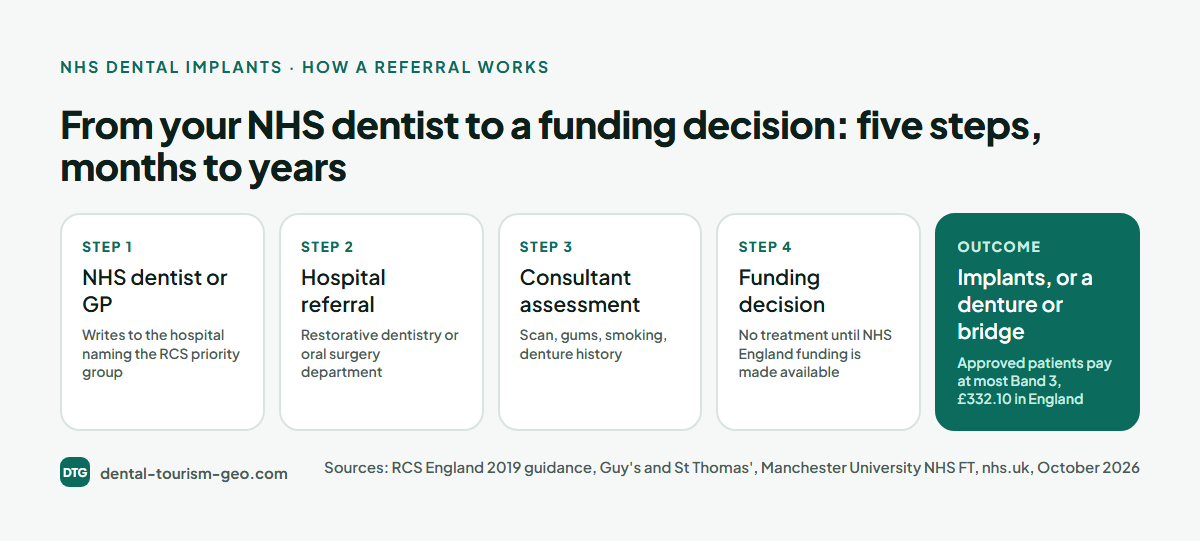
- Referral. Your dentist writes to the hospital, naming the priority group.
- Consultation with the restorative team.
- Funding. Manchester University NHS Foundation Trust states: “No treatment can be undertaken at the hospital until funding is made available.”
- Treatment and discharge. Guy’s and St Thomas’ estimates “treatment could take 6 to 12 months”, funded by NHS England and “valid for 5 years”.
Wales publishes waiting figures; we found none for restorative dentistry in England. Swansea Bay University Health Board reported on 24 September 2026 a median wait of 14 weeks, with 10% waiting 25 weeks or more.
How much do dental implants cost on the NHS if you are approved
If a hospital approves you, there is no separate tooth implant cost. Hospital dental treatment on the NHS is free, but the denture, bridge or crown fitted on top can be charged at the normal NHS rate, which in England is the Band 3 charge of £332.10 from 1 April 2026.
The nhs.uk charges page lists Band 3 at £332.10, up from £326.70 on 1 April 2026 according to the NHS Business Services Authority. Whether a hospital charges Band 3 for the teeth on your implants varies, so ask.
Wales scrapped bands on 1 April 2026 and charges per care package, a denture at £86.40 and a crown or bridge at £140.44. Scotland and Northern Ireland charge paying patients 80% of the cost up to £384 per course, per NHS Inform and nidirect.
In England, per nhs.uk (reviewed 11 February 2025), you pay nothing if you are under 18 or under 19 in full-time education, pregnant or had a baby in the last 12 months, on income-related Employment and Support Allowance, Pension Credit Guarantee Credit or low-earning Universal Credit, or hold an HC2 certificate. So “how to get free dental implants on NHS” has one answer: be approved, and be exempt.
What the NHS offers instead: dentures and bridges
For routine tooth loss the NHS offers a denture or a bridge, both within Band 3 at £332.10 in England, however many teeth are involved. That is a fraction of any private implant price, and for some mouths a bridge is simply the better treatment.
NHS false teeth are acrylic. Upper dentures work well for most people; lower full dentures sit on a thin ridge that shrinks, so they move when you chew. A bridge is a false tooth fixed to the neighbours, the right choice when the gap is one tooth and the neighbours are already heavily filled. Our partner clinics in Tbilisi quote bridges when a bridge is right.
Private dental implant costs in the UK (2026)
A single dental implant with a crown costs £2,000–£3,500 at most UK private practices, and All-on-4 runs £8,000–£18,000 per arch. DentistCost UK, reviewed 26 September 2026, surveyed 1,125 practices and puts the single-implant median at £2,500, with London 30–50% higher.
| Treatment | Typical UK private price | Source |
|---|---|---|
| Single implant with crown | £1,800–£3,500, median £2,500 | DentistCost UK, 26 Sep 2026 |
| Bone graft, when needed | £250–£1,500 extra | Same |
| All-on-4, one arch, outside London | £8,000–£14,000 | DentistCost UK All-on-4 guide, 1 Aug 2026 |
| All-on-4, one arch, London | £12,000–£18,000 | Same |
| Full mouth, both arches | £16,000–£28,000 and above | Same |
Dental implants UK cost moves with brand, bone grafts, sedation and city. Our price list and implant guide show what a complete quote contains.
Full mouth dental implants: NHS vs private UK vs abroad
Full mouth dental implants are not offered on the NHS for ordinary tooth loss, and privately in the UK both arches on All-on-4 cost £16,000–£28,000. In Tbilisi the same treatment with Straumann® or Bredent® implants costs £6,680, fixed in writing before you travel, and a single arch costs £3,340.
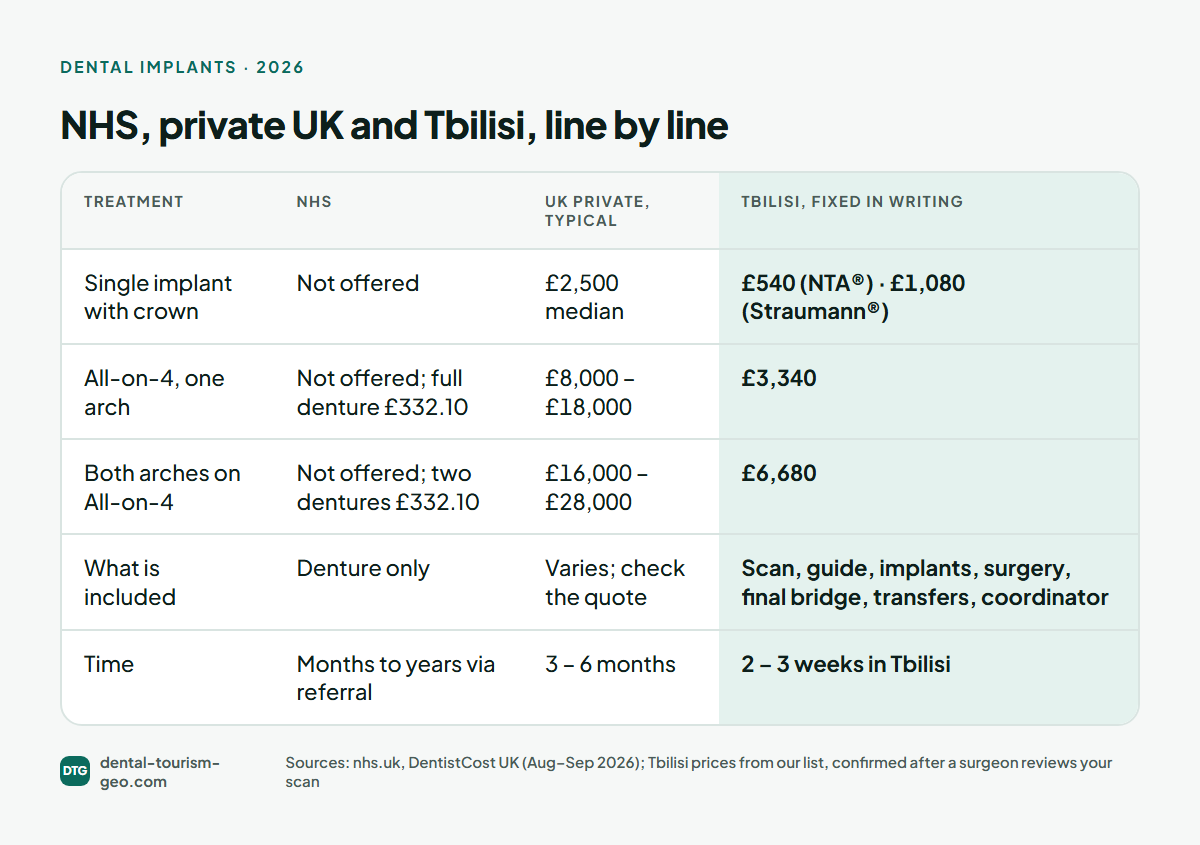
| Treatment | NHS | UK private, typical | Tbilisi, fixed |
|---|---|---|---|
| Single implant with crown | Not offered | £2,500 median | £540 (NTA®), £1,080 (Straumann®) |
| All-on-4, one arch | Not offered; full denture £332.10 | £8,000–£18,000, typically £13,000 | £3,340 |
| Both arches on All-on-4 | Not offered; two dentures £332.10 | £16,000–£28,000 | £6,680 |
| Included | Denture only | Varies; check the quote | Scan, guide, implants, surgery, final bridge, transfers, coordinator, passport, aftercare |
| Time | Months to years via referral | 3–6 months | 2–3 weeks; your written plan says whether the final bridge is fitted within the stay or at a second short visit |
Add travel, which we budget at £1,450 for flights and three weeks of hotel. One arch is then about £4,790 against a typical £13,000 at home, saving roughly £8,200. A single implant at £1,080 plus £1,450 is £2,530, the UK median, so one implant rarely justifies a trip. See the cost calculator and the full mouth implants page.
Is All-on-4 available on the NHS?
No, All-on-4 is a fixed bridge carried on four implants and the NHS does not fund it for people who have simply lost their teeth. The NHS answer for a whole jaw is a full denture at the Band 3 charge, and only the priority groups above may get implants to hold a denture.
“Same-day teeth” in adverts means a temporary bridge on the day of surgery and the permanent one once the implants have healed. Our All-on-4 page explains what the written plan says about timing and what is included.
Getting implants abroad: is it safe, and will a UK dentist look after them?
Implants placed abroad are as safe as the clinic and the planning behind them, and a UK dentist can maintain any implant if you bring proper records. The NHS will still see you for check-ups and emergencies, but it will not repair or replace work it would not have funded in the first place.
Six checks before booking:
- A named implant brand in writing, such as Straumann® or Bredent®.
- An implant passport listing every fixture.
- A CBCT scan before anyone quotes you.
- A written plan and fixed price that covers a possible graft.
- Enough time: 2–3 weeks for a full arch, about 10 days for single implants.
- A written guarantee that says who pays travel if work needs redoing.
NHS England’s November 2024 policy entitles patients who paid privately to NHS assessment and treatment to stabilise a problem, and earlier care “does not impact on their eligibility for NHS care in the future”. But care the NHS would not routinely fund “would not usually be offered or replaced once stabilisation has been achieved”. Will UK dentists work on Turkey teeth? Yes, though crowns are a different treatment; if that work has gone wrong, see what can be repaired.
What to do if you cannot wait: a decision path
Start with the NHS if you have any chance of qualifying, because the referral costs nothing and runs while you weigh other options. If you do not qualify, the order is a private UK quote, then a payment plan, then treatment abroad with the six checks above.
- Ask your NHS dentist whether you meet one of the six RCS groups. If yes, ask for a referral.
- If no, get two itemised private quotes.
- If the price is out of reach, ask about a payment plan and read the total repayable.
- For a single tooth, take the NHS bridge or denture seriously.
- For a whole arch, price treatment abroad with travel added, and insist on the six checks.
Does dental insurance or a dental plan cover implants in the UK?
Mostly no, because monthly capitation plans cover check-ups, hygiene and routine work and exclude implants outright. Standalone UK dental insurance either excludes implants or caps what it pays well below the cost of a single one, and few policies pay for treatment abroad. Our guide to dental insurance and treatment abroad covers the UK, US and Israel.
Frequently asked questions
Can you get dental implants on the NHS?
Only in exceptional clinical cases, through a hospital referral. The NHS funds implants for people who lost teeth to head and neck cancer surgery, severe trauma or inherited conditions such as hypodontia, or who cannot wear dentures after specialist attempts. Routine tooth loss does not qualify, and no high-street NHS dentist offers them.
How much are dental implants on the NHS?
There is no NHS price for an implant because it is not in the band system. If a hospital approves you, the surgery is free hospital care and the teeth fitted on the implants may be charged at Band 3, £332.10 in England from 1 April 2026. Exempt patients pay nothing.
Do I qualify for dental implants on the NHS?
Only if a hospital consultant places you in a Royal College of Surgeons priority group: cancer surgery, severe trauma with bone loss, congenital or inherited missing teeth, facial prostheses, repeated denture failure confirmed by a specialist, or severe mouth-lining disease. Gums must be healthy and you must not smoke.
Are full mouth dental implants available on the NHS?
Not for ordinary tooth loss. The NHS replaces a full set of teeth with dentures at the Band 3 charge. Only priority-group patients, for example after cancer surgery, may receive implants to stabilise a denture. Privately, both arches cost £16,000–£28,000 in the UK and £6,680 in Tbilisi with named brands.
Can you get free dental implants on the NHS?
Only if two things are true at once: a hospital has approved implants for a clinical reason, and you are exempt from NHS charges, for example under 18, pregnant or within 12 months of giving birth, on certain income-related benefits, or holding an HC2 certificate. There is no scheme for free implants on request.
Will a UK dentist treat implants placed abroad?
Yes, for maintenance and emergencies. NHS England’s 2024 policy confirms you keep full NHS entitlement and will be assessed and stabilised if something goes wrong, though the NHS will not rebuild private work. A private UK dentist can service any implant with a known brand and a passport.
The short version
- The NHS funds implants only for medical priority groups, via hospital referral and a funding decision. Approved patients pay at most £332.10 in England, or nothing if exempt.
- Everyone else gets a denture or bridge at £332.10. Privately in the UK a single implant is about £2,500 and an All-on-4 arch £8,000–£18,000.
- In Tbilisi a single implant is £540–£1,080 and an All-on-4 arch £3,340. One tooth rarely justifies the trip; a full arch saves roughly £8,000 after travel.
Send a panoramic X-ray or 3D scan on WhatsApp. A coordinator replies with a written plan reviewed by Dr Mamulashvili and a fixed price. Free, no deposit.