Americans asking who pays for dental implants get three answers: “no” from Medicare, “rarely” from Medicaid, and “about $1,000” from dental insurance. Here is what each covers, the real numbers, and four honest ways to pay less.
Original Medicare does not cover dental implants, except in narrow cases where dental work is tied to a covered medical treatment. Medicaid adult dental benefits vary by state and almost never include implants. Private dental insurance typically pays 50 percent of “major” work after a waiting period, up to an annual maximum of $1,000 to $2,000. On a $4,500 implant, roughly $1,000 back.
Does Medicare cover dental implants?
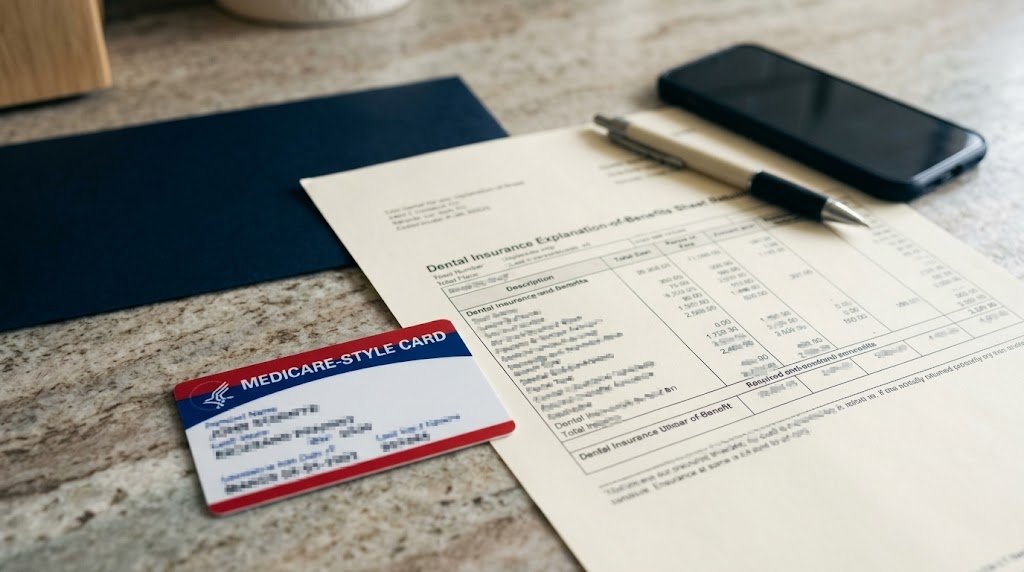
No. Original Medicare (Parts A and B) excludes routine dental care, and implants sit on the excluded list with cleanings, fillings, extractions and dentures. The only exceptions are dental services Medicare judges necessary for the success of a medical treatment it already covers.
Medicare’s dental services page (2026 figures) lists them: treatment tied to heart valve surgery, organ transplants, chemotherapy, head and neck cancer and dialysis. The 2023 CMS rule covers dental services “inextricably linked to” a covered medical service (KFF summary, updated November 25, 2024). A missing molar does not qualify.
Medicare Advantage (Part C) usually adds a capped dental benefit. KFF’s analysis of 2021 plans found an average cap of $1,300. Many exclude implants; check the Evidence of Coverage. A $23,500 arch still leaves $20,000 to find.
Does Medicaid cover dental implants?
Almost never. Adult dental is an optional Medicaid benefit, so each state decides what it covers, and most stop at extractions, fillings and sometimes dentures. Implants are treated as elective and excluded even in states with the broadest adult benefit.
The CareQuest Institute’s Medicaid Adult Dental Coverage Checker, reflecting benefits as of December 31, 2024, found only 11 states plus DC with an “extensive” adult benefit, and even there the list stops at dentures. Elsewhere coverage is limited or emergency only, usually an extraction.
Does dental insurance cover implants? How the math works
Sometimes, and never for much. A typical US plan pays 100 percent for preventive care, 80 percent for basic work and 50 percent for “major” work. Implants, when covered at all, are major, so you pay half, and the annual maximum cuts in long before the bill is paid.
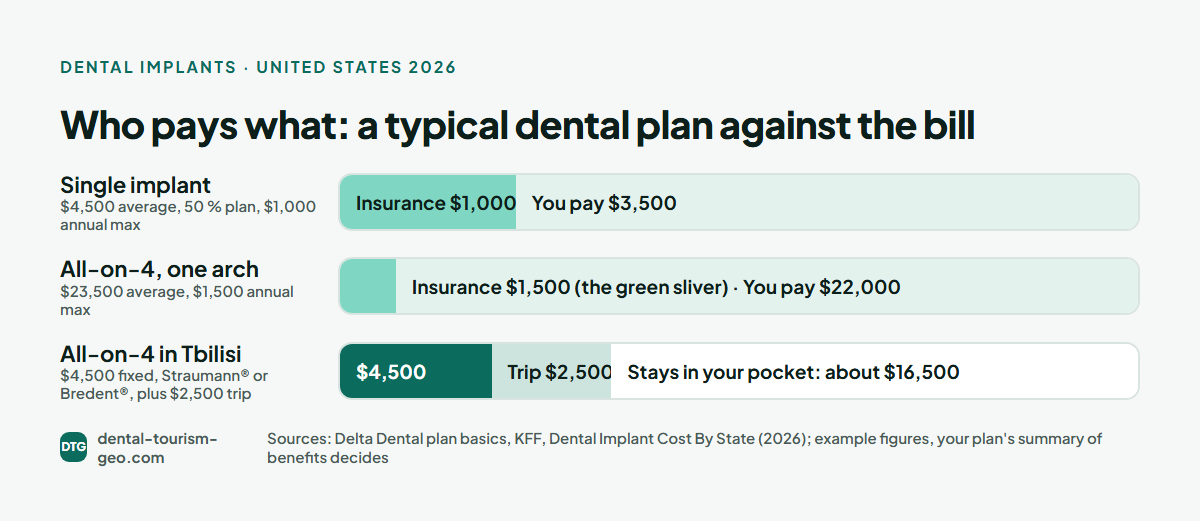
Delta Dental’s plan basics page describes this 100-80-50 structure and lists implants as major. The fine print matters more: a 6 to 12 month waiting period, annual maximums of $1,000 to $2,000, and often a “missing tooth clause” excluding teeth lost before the policy began. Table 1 assumes none of these bite.
| Treatment and price | 50 % of bill | Annual maximum | Insurance pays | You pay |
|---|---|---|---|---|
| Single implant with crown, $4,500 | $2,250 | $1,000 | $1,000 | $3,500 |
| All-on-4, one arch, $23,500 | $11,750 | $1,500 | $1,500 | $22,000 |
Insurance pays the maximum, and the maximum is small: a quarter of a single implant, 6 percent of an arch.
What Delta Dental, Aetna, Humana, Cigna and MetLife cover
None of the five covers implants as a company. Each sells dozens of plans, and coverage depends on the one you or your employer chose. The answer is in your Summary of Benefits under “exclusions and limitations,” never in the brand name.
Delta Dental lists implants as a major service, but employer plans can remove them. Aetna‘s pages do not mention implants. Humana says coverage depends on the plan. Cigna states that many plans exclude implants and names one of its own with a $2,000 lifetime maximum. MetLife points to the certificate of insurance. Ask for a written pre-treatment estimate, and whether the plan pays on the implant or only the crown.
Full mouth dental implants with insurance: why the annual maximum makes insurance almost irrelevant
On a full-mouth case, dental insurance covers a rounding error. A $1,500 annual maximum against a $30,000 to $50,000 treatment leaves 95 percent of the bill with you, and that is the best case, where implants are not excluded and the waiting period has passed.
Three moves get a little more: split treatment across two plan years to collect two maximums, get pre-authorization in writing, and if tooth loss followed an accident or illness, ask whether medical insurance covers the surgery. Does insurance cover All-on-4 dental implants? A few plans pay toward the fixtures up to the maximum; most exclude implant-supported prosthetics (see our full-mouth page).
Can you get free dental implants?
Very rarely, and “free” is usually a marketing hook. The real options are a dental school, a clinical trial, VA dental care for a narrow group of veterans, and a few charities with long waiting lists. “Dental implant grants” are almost always lead generation for private clinics.
Dental schools place implants under supervision at a fraction of private fees, but slowly; the ADA’s program finder lists every school. ClinicalTrials.gov occasionally lists implant studies. The VA’s dental care page (updated January 12, 2026) lists who qualifies, mainly service-connected dental conditions or a 100 percent rating. A grant site that wants your phone number before naming an amount is collecting leads. There is no federal implant grant.
What dental implants cost without insurance in the US (2026)
A single implant with crown costs $3,000 to $5,000 in most of the country. A full-arch All-on-4 runs $14,000 to $32,000, typically around $23,500, and both arches land between $30,000 and $65,000. Your zip code moves the price more than the implant brand does.
These ranges match the Dental Implant Cost By State survey (updated for 2026): single implant average $4,500, All-on-4 $23,500 per arch, full mouth $44,500.
| Treatment | US range (2026) | US typical | Tbilisi fixed price, from |
|---|---|---|---|
| Single implant with zirconia crown | $3,000 to $5,000 | $4,500 | $730 (NTA®) or $1,450 (Straumann®) |
| All-on-4, one arch | $14,000 to $32,000 | $23,500 | $4,500 |
| Both arches on All-on-4 | $30,000 to $65,000 | $44,500 | $9,000 |
US quotes usually exclude the CBCT scan, extractions, grafting and sedation. Our price list shows what Tbilisi figures include; the cost calculator puts your quote next to them.
Financing and payment plans: the real cost of interest
Dental implants financing fills the gap insurance leaves, and it is where patients lose the most money. The common routes are medical credit cards such as CareCredit, in-house clinic plans and personal loans. Each is manageable on a $3,500 balance and dangerous on a $25,000 one.
Medical cards sell “no interest if paid in full” promotions (CareCredit’s page: purchases of $200 or more). The catch is deferred interest: miss the deadline by a dollar and interest is charged back to the purchase date on the whole amount. The Consumer Financial Protection Bureau’s report (May 4, 2023) found patients paid about $1 billion in deferred interest from 2018 to 2020.
A worked example: finance $25,000 at 17.9 percent over 60 months and you pay about $633 a month and $13,000 in interest. A credit union loan is often cheaper; shrinking the principal is better.
Are dental implants tax deductible?
Yes, if you itemize and your medical expenses for the year exceed 7.5 percent of your adjusted gross income. Only the part above that line is deductible. Implants count as dental treatment and artificial teeth, both of which the IRS lists as qualifying medical expenses.
IRS Publication 502 (for 2025 returns) sets the rules. Transportation “primarily for and essential to medical care” qualifies, including plane fare. Lodging is capped at $50 per night per person, the care must be in a licensed hospital or equivalent, and the trip must have no significant vacation element. The publication does not limit care to US providers.
The four cheapest honest routes
The cheapest way to get dental implants is one of four ordinary choices: phase the work, buy implant and crown separately, use a dental school, or travel with proper checks. Each costs time or convenience, which is why it costs less money.
- Phase the treatment. Extractions and an interim denture now, implants next year. You collect two insurance maximums.
- Get implant-only quotes. A periodontist places the implant, your own dentist makes the crown. Two invoices often beat one bundle.
- Use a dental school. Slow, supervised, far cheaper.
- Go abroad with checks. For one implant this rarely pays: $730 in Tbilisi plus a $2,500 trip is about the home price. For a full arch or two, the saving is $15,000 to $35,000 after travel.
Distrust any “affordable dental implants near me” offer priced before anyone has seen a 3D scan. Bone volume decides the real price.
Going abroad for implants: Mexico vs Georgia vs home
Mexico is closer and Georgia is cheaper, and both are far below US prices for a full arch. A Tijuana All-on-4 costs $8,000 to $12,000 per arch. Tbilisi is $4,500 with a named Swiss or German implant brand, transfer and coordinator included. Home is $23,500.
Mexico figures: Real Dental Costs (reviewed May 2026). Tbilisi prices are fixed before you fly; see the All-on-4 page.
| United States | Mexico (Tijuana) | Georgia (Tbilisi) | |
|---|---|---|---|
| All-on-4, one arch | $14,000 to $32,000 | $8,000 to $12,000 | $4,500 fixed |
| Both arches | $30,000 to $65,000 | About $16,000 to $24,000 | $9,000 fixed |
| Implant brands | Varies by practice | Varies by clinic | Straumann® (Switzerland), Bredent® (Germany); budget B&B Dental®, NTA® |
| Stay | Several visits, 4 to 8 months | Two trips of about a week | One trip of 2 to 3 weeks for most cases |
| Flight from New York | None | About 6 hours, then the border | One stop, about 13 to 16 hours |
| Aftercare | Your own dentist | Return trip or your own dentist | Implant passport for your dentist; coordinator on WhatsApp |
Most US dentists will maintain implants placed elsewhere but hesitate when the brand is unknown. That is why we use Straumann® and Bredent®, both stocked in the US, and why every patient leaves with an implant passport listing fixture, size and lot number. Our post on dental insurance and treatment abroad covers claiming for overseas work.
Frequently asked questions
Does Medicare cover dental implants for seniors?
No. Original Medicare excludes implants as routine dental care. Since 2023 it pays for dental work only when tied to a covered medical treatment such as a transplant, heart valve surgery, cancer therapy or dialysis. Medicare Advantage plans may add a capped dental benefit; many still exclude implants.
Does Medicaid cover dental implants in any state?
No state lists implants in its adult Medicaid dental schedule. As of December 31, 2024, CareQuest counted 11 states and DC with an “extensive” adult benefit, and even those cover dentures rather than implants. Most states offer limited or emergency-only adult care.
What percentage of dental implants does insurance pay?
When a plan covers implants, it pays 50 percent as a major service, up to the annual maximum of $1,000 to $2,000. On a $4,500 implant that is about $1,000 to $1,500; on a $23,500 arch it is the same maximum, around 6 percent. Waiting periods and missing tooth clauses can cut it to zero.
How can I get free dental implants?
Truly free implants are almost nonexistent. Dental schools offer supervised treatment at a steep discount but slowly. Clinical trials occasionally cover implants for eligible volunteers. Veterans in specific VA eligibility classes can receive implants through the VA. “Implant grant” websites are lead generation for clinics, not aid.
Are dental implants tax deductible?
Yes. Implants are a qualifying medical expense under IRS Publication 502. You can deduct medical costs above 7.5 percent of adjusted gross income if you itemize. Airfare for treatment and lodging up to $50 per night per person also count, and the rules do not require care to be given in the United States.
Will my US dentist maintain implants placed abroad?
Usually yes, provided they know what is in your mouth. Dentists hesitate when the brand is unknown because parts differ by manufacturer. Choose brands stocked in the US, such as Straumann® or Bredent®, bring home an implant passport with the fixture details, and ask your dentist before you travel.
The short version
- Original Medicare does not cover implants, Medicaid almost never does, and dental insurance pays its $1,000 to $2,000 annual maximum, no more.
- Without insurance a US implant costs $3,000 to $5,000 and an All-on-4 arch about $23,500. Financing $25,000 over five years adds about $13,000 interest.
- Implants are tax deductible above 7.5 percent of income, travel included. In Tbilisi a single implant is from $730 and an All-on-4 arch $4,500, fixed before you fly.
Send your 3D scan or US quote on WhatsApp and a surgeon in Tbilisi replies with a written plan and a fixed price. Free, no deposit. Replies within hours, Monday to Saturday, US hours included.