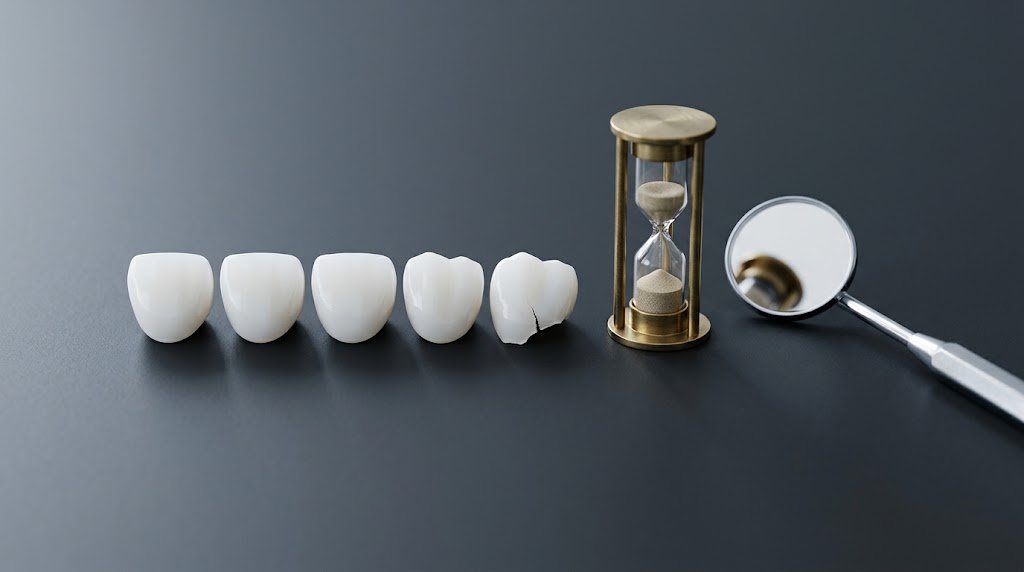
“Turkey teeth” is the name British patients gave to a full set of crowns, often 20 or more, fitted abroad in five or six days. The videos show the day the temporaries come off. They do not show year five, when the first tooth under a crown dies.
A well-made ceramic crown lasts 10 to 15 years, and published reviews show 92 to 97% survive the first five. Turkey teeth are the same crowns made fast on healthy teeth that have lost 63 to 72% of their bulk to the drill, so the weak point is the tooth underneath rather than the ceramic. About 5% of crowned teeth lose their nerve. With 20 crowns that is one root canal per patient on average, and the chips and replacements follow between years two and ten.
Table of Contents
ToggleWhat are Turkey teeth made of?
Turkey teeth are full crowns, usually zirconia or metal-ceramic, cemented over teeth cut down to small pegs. Clinics often sell them as veneers. A veneer is a shell 0.3 to 0.8 mm thick bonded to the front of the tooth; a crown covers the whole tooth.
Zirconia is a white ceramic milled from a block, strong and fast to make. Metal-ceramic has a metal cap with porcelain baked on and the longest track record. A lithium disilicate crown needs 1.0 to 1.5 mm off the front, 1.5 to 2.0 mm off the biting edge and 1.0 mm at the gum line; a veneer on the same manufacturer’s guide needs depth cuts of 0.6 to 0.8 mm and can be as thin as 0.3 mm. By weight, a veneer preparation removes 3 to 30% of the crown of the tooth, a full crown 63 to 72% (Edelhoff and Sorensen, 2002).
How long do Turkey teeth last?
The ceramic is likely to last. Reviews put 5-year survival of single crowns at 94.7% for metal-ceramic, 96.6% for lithium disilicate and 92.1% for layered zirconia, and one long study found 97% of metal-ceramic crowns in place at 10 years. The tooth under a rushed crown is the part that fails.
The 5-year figures are from Sailer and colleagues, Dental Materials, 2015. The 10-year figure is from Walton’s 2013 follow-up of 2,340 metal-ceramic crowns, still 85% at 25 years. A 2021 summary of 38 systematic reviews gave 91 to 96% at 5 years for zirconia crowns on natural teeth.
Those crowns were placed by specialists on teeth that needed them. Nobody has published survival for 20 crowns fitted in five days on healthy teeth. What exists is the British Dental Association’s July 2022 survey of 1,000 dentists: crowns were the treatment most likely to need follow-up after a trip abroad, named by 87%, ahead of implants at 85%. See our Turkey teeth gone wrong page.
Why Turkey teeth fail early
Early failures come from four things: too much tooth removed, nerves that die, crown edges that leak, and a new bite with no night guard. All four come with a package that prepares 20 teeth on day one and cements on day five.
- Over-reduction. Taking 1.5 to 2 mm off a healthy front tooth brings the drill close to the pulp.
- Pulp death. A 2023 meta-analysis of 37 studies and 11,615 teeth found 5.02% of teeth lose their nerve after a crown and 3.63% develop a root-tip infection. With 20 crowns, the chance that at least one needs a root canal is about 64% (our arithmetic from the 5% figure).
- Leaking margins. The crown edge must meet the tooth exactly, usually just under the gum. Rushed impressions give bleeding gums in year one and decay by year five. In the BDA survey, 86% of dentists named failed treatment and 76% named pain.
- No night guard. Twenty new crowns change how your teeth meet. Grind at night and zirconia chips.
Year one, year five, year ten
Year one brings sensitivity, bite problems and sore gums. Years two to five bring the first root canals, chips and dark lines at the gum. By year ten most patients are pricing a second set. The timeline is typical rather than universal.
Year one. Hot and cold sensitivity on teeth cut deep. Gums that bleed where a margin sits too far under them.
Years two to five. A tooth goes quiet, then flares up. That is the nerve dying; the fix is a root canal through the crown. Gums recede and a grey line shows on metal-ceramic.
Years five to ten. Chips become fractures. Teeth with root infections may be lost and need implants. The rest are reaching the age when replacement starts.
How long do veneers last?
Porcelain veneers last 10 to 15 years with good odds, composite 5 to 7 before polishing or replacement. A meta-analysis of 13 studies found 94% of glass-ceramic veneers (the E.max family) in place at a median of 9 years. Composite reached 88% over 2 to 8 years.
The porcelain figure is from Morimoto and colleagues, International Journal of Prosthodontics, 2016: 89% overall at 9 years, 94% for glass-ceramic, 87% for older feldspathic porcelain. The composite figure is from Lim and colleagues, 2023, who pooled trials with 24 to 97 months of follow-up; the main complaints were roughness, colour mismatch and staining at the edges.
Two things make a veneer last: it is bonded to enamel, and the nerve is untouched. A full crown gives up both. Our veneers and crowns page explains when each is right.
How long do crowns last?
A crown on a tooth that needed one lasts 10 to 15 years and often longer. The best long-term data are for metal-ceramic: 97% at 10 years and 85% at 25 in a specialist practice. Zirconia data are solid to 5 years, at 91 to 96%, and thin after that.
What shortens a crown’s life has little to do with the ceramic. Grinding chips it. Decay at the margin undermines it. DentistCost UK estimates 15 to 25 years for zirconia; the trial results are in the table.
| Restoration | Published survival | Main complication | Source |
|---|---|---|---|
| Metal-ceramic crown | 94.7% at 5 years; 97% at 10, 85% at 25 | Nerve death, porcelain fracture | Sailer 2015; Walton 2013 |
| Zirconia crown, porcelain-layered | 92.1% at 5 years | Chipping of the layer | Sailer 2015 |
| Zirconia crown, all types | 91 to 96% at 5 years | Chipping | Laumbacher 2021 |
| Lithium disilicate (E.max) crown | 96.6% at 5 years | Fracture | Sailer 2015 |
| Glass-ceramic (E.max) veneer | 94% at 9 years (median) | Chipping 4%, debonding 2% | Morimoto 2016 |
| Composite veneer | 88% over 2 to 8 years | Staining, roughness | Lim 2023 |
Gum disease and Turkey teeth
With untreated gum disease, crowns fail at the gum first. A careful clinic treats the gums, waits for them to settle, then takes impressions. A five-day package cannot, so it crowns over the disease or does not look for it.
Gum disease is common after 50 and often silent: bleeding on brushing, gums pulling back, teeth slightly loose. Crown a tooth in that state and the margin is exposed within a year as the gum recedes. Before any crowns or veneers, anywhere, ask for a periodontal chart and a recent 3D scan. No chart means nobody checked.
Are Turkey teeth safe?
Zirconia and metal-ceramic are safe materials used in every UK practice. The method is the risk. The General Dental Council advises speaking to your own dentist first, and the BDA found that 86% of dentists had treated problems from work done abroad.
The GDC’s guidance on going abroad for dental care is blunt. Ask who will treat you and their qualifications. Ask, in its words, “What happens if I am unhappy with the results? Who pays for the extra flights, hotel and remedial work?” The GDC can investigate a UK-registered dentist. It has no power over a clinic abroad.
The BDA survey adds the cost: 65% of dentists said repairs cost the patient at least £500 and 51% said over £1,000. Georgia is abroad too, and the same questions apply to us. Our answers are on the your trip page.
Can Turkey teeth be redone, and what does it cost?
Yes. A failed crown is cut off and a new one made; a dead nerve gets a root canal first. In the UK that is £400 to £1,200 per crown and £300 to £900 per root canal at a general dentist. In Tbilisi a zirconia crown is £213 and a root canal from £98, fixed in writing.
The UK figures are from DentistCost UK’s crown page (reviewed 26 September 2026) and its root canal guide (updated 26 September 2026). Neither lists a fee for removing an old crown. On the NHS, if a dentist takes the case, all crowns in one course fall under Band 3 at £332.10.
| Repair | UK private (DentistCost UK, Sept 2026) | Tbilisi, fixed |
|---|---|---|
| Replacement crown, any material | £400 to £1,200 | £213 (zirconia) |
| Replacement crown, zirconia | £650 to £1,100 | £213 |
| Root canal, front tooth | £300 to £500 | from £98 |
| Root canal, molar | £500 to £900 | from £98 |
| Root canal, molar, specialist | £900 to £1,500 | from £98 |
| NHS Band 3, England, all crowns in one course | £332.10 | n/a |
A fictional example: ten failing upper crowns and two dead nerves cost £4,600 to £13,800 in the UK. In Tbilisi the same work is £2,326, plus £1,450 for flights and hotel on our standard three-week budget line. For one or two crowns, stay at home. See our prices page.
How to make any crown last
Four habits add years to a crown: clean the margin daily, wear a night guard if you grind, see a hygienist twice a year, and fix a chip the month it happens. None costs more than the crown it protects.
- Floss or use interdental brushes at the gum line of every crown. Decay at the margin does not hurt until it is deep.
- Act on a dull ache or pain on biting. That is the nerve. A root canal done early saves the tooth.
- Keep the paperwork: material, brand, shade and lab. We give this in writing.
Frequently asked questions
Do Turkey teeth last forever?
No. Crowns are replaced, typically after 10 to 15 years, and sooner if the tooth under them dies or decays at the edge. Each replacement removes a little more tooth. A set fitted at 30 is realistically on its third set by 60.
Can you get Turkey teeth with gum disease?
You can, but you should not. Crowns over active gum disease lose their gum cover within a year and loosen as bone is lost. Treat the gums first, wait about three months, then restore. A clinic that skips that step is selling a failure.
Are Turkey teeth veneers or crowns?
Crowns, almost always. A veneer covers the front of the tooth and removes 3 to 30% of it; a crown covers all of it and removes 63 to 72%. Clinics say “veneers” because it sounds gentler. If the plan says 1.5 mm reduction or “full coverage”, it is a crown.
What happens when Turkey teeth fail?
A chip is polished or the crown replaced. A dead nerve means a root canal through the crown, then a new crown. Decay at the edge means the crown off, the decay out, and a new crown or, if too little tooth is left, an implant.
Can Turkey teeth be replaced with veneers?
Rarely. A veneer needs enamel to bond to. Once a tooth has been cut for a crown, that enamel is gone, so the replacement is another crown. This is the main reason we steer patients away from crowns on healthy front teeth.
Is Georgia any different from Turkey?
The country matters less than the plan. What we change is the method: a prosthodontist reviews your scan before you book, veneers where a veneer will do, crowns only where a tooth needs one, and every price fixed in writing.
The short version
- Turkey teeth are crowns on shaved-down teeth. The ceramic survives in 92 to 97% of cases at five years; about 5% of the teeth under it lose their nerve.
- Done properly, E.max veneers last 10 to 15 years and crowns 10 to 15 or more, because the enamel and the nerve are kept.
- Redoing a crown costs £400 to £1,200 in the UK and £213 in Tbilisi; a root canal £300 to £900 against from £98. For one or two teeth, stay at home.
Send photos and a recent 3D scan on WhatsApp. A prosthodontist in Tbilisi tells you in writing which teeth need a crown, which a veneer, and which nothing, with a fixed price. Free, no deposit.