Every clinic in Israel now advertises “teeth in a day”. The sentence missing from the adverts: the teeth you get that day are temporary, and whether the implants survive depends on your bone, not on how fast the clinic works. Here we explain who the treatment really suits, what it costs in Israel and in Tbilisi, what the kupat holim (Israel’s public health funds) actually gives, and the risks that never appear in the advert.
Same-day dental implants (immediate loading) means the implants are placed and a fixed temporary bridge is screwed onto them within 24 hours. The treatment suits people with enough bone, good primary stability of the implants, controlled diabetes and little or no smoking. The final bridge comes only after 3 to 6 months of healing. In Israel, one arch costs ₪35,000–70,000 according to the price lists. In Tbilisi the fixed price per arch on All-on-4 is ₪13,600 (about £3,340 / $4,500), including the final bridge.
Table of Contents
ToggleWhat exactly is “teeth in a day”?
“Teeth in a day” is the marketing name for immediate loading: the surgeon places 4 to 6 implants in the jaw and attaches a temporary bridge to them the same day or the next. In delayed loading, the standard method, the implants stay covered by the gum for 3 to 6 months, and teeth are built on them only after the bone has bonded to them.
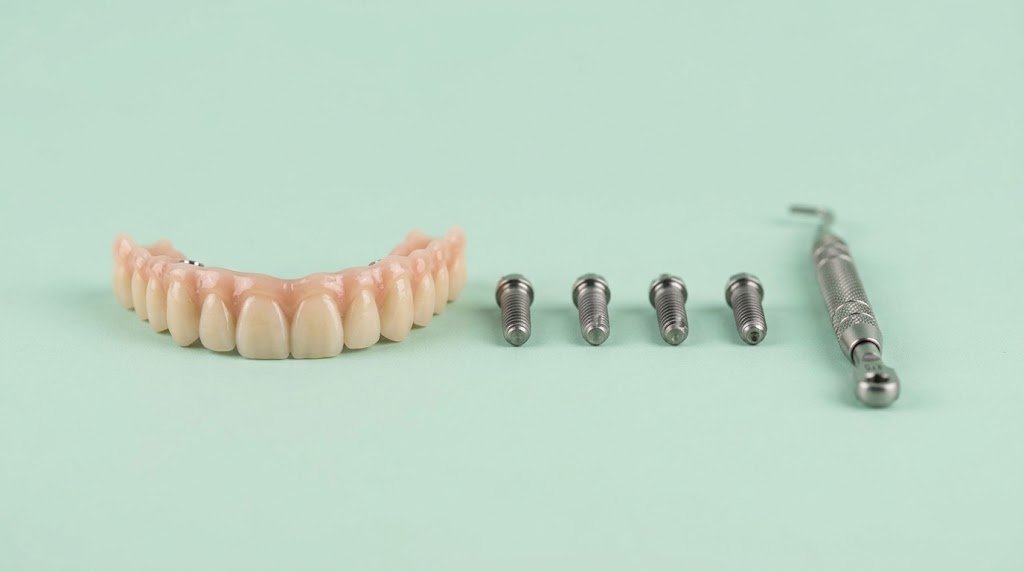
The most common method for a full arch is All-on-4: two straight implants at the front of the jaw and two rear implants tilted at 30 to 45 degrees, which bypass the nerve in the lower jaw and the sinus in the upper jaw. In soft bone or a long upper jaw, All-on-6 is planned. What you leave the clinic with is a temporary bridge made of acrylic or PMMA. It looks good and lets you eat soft food, but the final zirconia bridge is made only after the bone has fused with the implants.
Who it suits and who it does not
Immediate loading suits people who have enough bone volume, whose implants stabilise during surgery at an insertion torque of about 35 Ncm or more, who do not smoke or smoke little, whose diabetes is controlled and who do not grind their teeth hard. Anyone who fails one of these conditions usually needs delayed loading, and sometimes bone grafting beforehand.
| Criterion | Suitable for immediate loading | Delayed loading is better |
|---|---|---|
| Bone volume and quality | Dense bone, enough height and width on the CBCT | Soft or thin bone, especially in the rear upper jaw |
| Insertion torque | About 35 Ncm or more on all implants | One or more implants below the threshold |
| Smoking | Non-smoker or light smoker | Heavy smoker |
| Diabetes | Controlled | Uncontrolled |
| Teeth grinding | None or mild, with a night guard | Heavy grinding |
| Active infection | None | Abscess or active gum disease |
| Bisphosphonates | Not taking | Intravenous treatment, doctor’s clearance required |
The decision whether to load the implants the same day is made during surgery, when the surgeon measures the torque of each implant. A clinic that sold you a package at one price is under pressure to load even when the reading is borderline. An honest clinic says in advance that there is a plan B: if the torque is low, you leave with a removable temporary denture. If nobody has talked to you about plan B, that is a warning sign.
What same-day dental implants cost in Israel (2026)
According to three Israeli price lists we checked in October 2026, same-day dental implants for one arch cost between ₪35,000 and ₪70,000 in Israel, and up to ₪75,000 with All-on-6. The price usually includes the implants and the temporary bridge, and not always the final bridge, the scan and the anaesthesia.
| Source | All-on-4, one arch | Notes |
|---|---|---|
| DentalGuide (no date on the page) | ₪38,000–50,000 | “The quoted price is for the implant placement only”, additional treatments charged extra |
| Perfecshen (updated for 2026) | ₪40,000–70,000 | Listed under “same-day dental implants, price for one arch” |
| iDen (checked October 2026) | ₪35,000–60,000 | All-on-6: ₪45,000–75,000. 3D CT scan ₪1,000–1,500 separately |
| Tbilisi, Dental Tourism Georgia | ₪13,600 (£3,340 / $4,500) | Fixed price including CBCT, implants, surgery, final bridge, transfers and coordinator. All-on-6: ₪17,500 (£4,300 / $5,800) |
What the Israeli quote usually leaves out: the final bridge (some clinics price only the temporary one), CBCT at about ₪1,000–1,500, bone grafting at ₪2,500–5,000, a sinus lift at ₪4,000–8,000 (per the iDen price list), sedation and extractions. Ask for a final figure in writing before you pay.
Same-day dental implants in Jerusalem, in the north or in Tel Aviv cost by the same logic: the price is set by the brand, the amount of bone and what is included, not by the city. Our full price list: the prices page.
A simple calculation: one arch in Tbilisi ₪13,600 (£3,340 / $4,500), plus about ₪5,000 for flights and hotel, about ₪18,600 in total, against ₪35,000–70,000 in Israel. Both arches in Tbilisi: ₪27,200 (£6,680 / $9,000) plus ₪5,000, against ₪70,000–140,000 in Israel.
What the kupat holim gives (Clalit Platinum, Maccabi Zahav, Meuhedet, Leumit)
No kupat holim covers dental implants for adults aged 18 to 72 from the public health basket. The supplementary plans (Clalit Platinum, Maccabi Zahav and the like are the paid top-up tiers of Israel’s four public health funds) give a percentage discount off the price list of the funds’ own clinics after a waiting period, not payment for the treatment. The discount applies only within the network in Israel and not to treatment abroad.
- Clalit Platinum: according to the Clalit Mushlam dental page, Platinum members are entitled to a 50% discount on prosthetic treatments including implants, after 12 months of membership, at Clalit Smile clinics. The government benefits document confirms a 12-month waiting period for “implants and restorations on implants”.
- Maccabi Zahav and Maccabi Sheli: according to Maccabi’s entitlement page for restorative treatments, implants and anaesthesia, Maccabi Zahav gives a 25% discount off the Maccabi-Dent price list and Maccabi Sheli 43%, after a waiting period of up to 12 months (the page for age 72 and over, updated 1 June 2025, states 12 months for Zahav). You must stay on the same plan throughout the treatment, otherwise you pay the difference.
- Meuhedet and Leumit: the supplementary plans give a discount off the price list of the fund’s own clinics. We did not find an explicit implant discount percentage for ages 18 to 72 on the funds’ pages, so check directly with the fund.
So the question “dental implants Clalit Platinum price” has no single answer. The discount is 50% off the Clalit Smile price list, but the list is made up of items: implant, abutment, crown, bridge, scan, bone graft. And even after a 50% discount, a full arch in Israel usually remains more expensive than an arch in Tbilisi including flights. From age 72 the picture changes, and at Maccabi a metal implant is given to members aged 72 and over even without a waiting period.
General anaesthesia or sedation?
Most full-arch implant surgery worldwide is done under local anaesthesia with intravenous sedation, not general anaesthesia. General anaesthesia is needed only for a small share of patients: severe dental anxiety, a strong gag reflex, or a neurological condition that makes lying still for two to four hours difficult.
In Israel, dental implants under general anaesthesia require a specialist anaesthetist, a licensed clinic and monitoring until discharge. The cost is added to the implant price and is not included in the advertised price. In Tbilisi our partner clinics work under local anaesthesia, and sedation is priced in writing before you fly. For people with uncontrolled diabetes or heart failure, general anaesthesia is sometimes a bigger risk than the implant surgery itself, so it should be discussed with your own doctor and not only with the clinic.
Recovery time: what you can eat, when you go back to work, when you get the final bridge
Recovery from the surgery itself takes about one to two weeks, a return to office work is usually possible after 2 to 4 days, and the final bridge comes after 3 to 6 months. Throughout that period you eat soft food on the temporary bridge, even when you feel you could manage more.
- First 24 hours: swelling, slight bleeding and pain controlled with ordinary painkillers. Cold, soft food, no straws, no smoking.
- Week 1: swelling peaks on day two or three and then subsides. Soft food, gentle rinses, stitches out at the end of the week.
- Weeks 2 to 3: the gums heal, your speech adjusts to the bridge. Bite check and adjustment of the temporary bridge. This stage is why we ask you to stay in Tbilisi for 2 to 3 weeks.
- Months 3 to 6: the bone fuses with the implants. The temporary bridge is replaced by the final one, made to the bite that has settled.
Until the final bridge, avoid hard bread, seeds, nuts and fibrous meat. A hard bite on implants that have not yet fused is force transferred to the bone, and that is a cause of early failure.
Drawbacks and risks nobody mentions
The main risk of immediate loading is implant failure in the first months. A systematic review of 39 controlled studies found 96.8% survival for immediately loaded implants against 98.6% for delayed loading. The difference is small but real, which is why you choose by your bone and not by the flight schedule.
The review, Chen et al., Journal of Prosthetic Dentistry, 2019, covered 1,868 patients and 3,746 implants. At implant level the difference was statistically significant, at patient level it was not. In plain words: in well-selected patients both methods work, and in borderline patients immediate loading adds risk. The Cochrane review on loading times reached a similar conclusion.
Further drawbacks that get less attention:
- Fracture of the temporary bridge. Acrylic breaks. In Israel you go back to the clinic. Three months after a five-day package abroad, there is nobody to go back to.
- Speech and saliva. The temporary bridge is thicker than the final one, and in the first weeks some patients speak differently. It passes, but it is worth knowing in advance.
- A restricted menu for 3 to 6 months.
- The second visit. Anyone selling you “in a day” without talking about the appointments for the final bridge is not telling the whole story.
- Implant failure means removing the implant, months of healing and sometimes bone grafting before a second attempt. A good quote states who pays.
Implants without bone: tilted All-on-4, zygomatic, basal
“Dental implants without bone” almost always means little bone in the rear areas, not an absence of bone. In most cases the solution is All-on-4 with tilted rear implants that use the front bone. When there is not enough bone even at the front of the upper jaw, the options are bone grafting and waiting, or zygomatic implants in the cheekbone.
Zygomatic implants are a bigger operation, for an experienced oral and maxillofacial surgeon only, with a higher risk of sinus complications. Basal implants, marketed as an “immediate solution without bone”, are controversial in the professional literature, and a second opinion is advisable. In a large share of cases the safer route is simply slower: bone grafting or a sinus lift, 4 to 6 months of healing, then delayed loading. In Israel this adds ₪2,500–8,000 according to the iDen price list, and in Tbilisi it is priced in writing before you fly. Anyone who promises a fixed arch in one day on insufficient bone is promising something the bone will not deliver.
“In a day” in Turkey against a 2 to 3 week plan in Tbilisi
The difference between a “teeth in a day in Turkey” package and our plan in Tbilisi is not the surgery, which is similar, but what happens in the two weeks and the months after it. A five-day package sends you home before the stitches come out and with nobody to adjust the bite. We ask for 2 to 3 weeks, and the written plan states whether the final bridge is fitted within the stay or on a short second visit, and what is included in the price.
| What to check | 5-day “in a day” package | 2 to 3 week Tbilisi plan |
|---|---|---|
| Price | Package price, usually without a breakdown | ₪13,600 (£3,340 / $4,500) per arch, written quote with a full breakdown before booking |
| Implant brand | Not always named in the advert | Straumann® or Bredent® named in the quote, budget packages on B&B Dental® or NTA® |
| Days in the country | 4 to 6 | 14 to 21, including stitch check and bite adjustment |
| Who fits the final bridge | A dentist in Israel whom you will have to find, and who may refuse to work on unfamiliar components | The same team, included in the price; the timing, within the stay or on a short second visit, is written in the plan |
| Follow-up | On your own initiative | Coordinator on WhatsApp, follow-up plan and implant passport |
Why we refuse to plan a full arch in five days: extractions, implant placement, temporary bridge, stitch check and bite adjustment are five procedures, and when they are squeezed into five days there is no room for a single problem. Swelling that does not go down, a borderline implant or a bridge that gets in the way of biting needs a few more days on site. We want to see you on days 7 to 10 and on days 14 to 18 before you fly. Details on the Your Trip page. The implant passport matters for Israelis: any dentist in Israel can order parts from it.
How to check a “teeth in a day” quote: 7 questions
A good quote answers seven questions in writing, before you pay a deposit. If the clinic answers only by phone, or asks you to “come for a consultation and then we’ll see”, the published price is not the price you will pay.
- What is the implant brand and catalogue number? Is there an implant passport?
- Was a CBCT taken and does the price include it?
- Does the price include the final bridge, and what material is it made of?
- What is the temporary bridge made of, and what happens if it breaks?
- What is plan B if the torque during surgery is below the threshold?
- Who fits the final bridge, when, and what does it cost?
- What happens if an implant fails in the first year, and who pays?
In Tbilisi your plan is also checked by Dr Ketevan Mamulashvili, a prosthodontist, before a written quote is sent. She does not operate, she checks that the plan makes sense.
Frequently asked questions
What are same-day dental implants?
It is the marketing name for immediate loading: four to six implants are placed in the jaw and a fixed temporary bridge is screwed onto them the same day or the next. The temporary bridge is made of acrylic and serves for 3 to 6 months, until the bone fuses with the implants. Then the final bridge is made. In most adverts “teeth in a day” and All-on-4 describe the same treatment.
Who are same-day dental implants suitable for?
People who have enough bone on the CBCT, whose implants stabilise during surgery at a torque of about 35 Ncm or more, whose diabetes is controlled, who are not heavy smokers and do not grind their teeth hard. Anyone who does not meet these conditions gets a better result with delayed loading, sometimes with bone grafting beforehand. The final decision is made during surgery.
How much do same-day dental implants cost in Israel?
According to the DentalGuide, Perfecshen and iDen price lists we checked in October 2026, one arch on All-on-4 costs ₪35,000–70,000 in Israel, and All-on-6 up to ₪75,000. Always check whether the price includes the final bridge, CBCT and anaesthesia. In Tbilisi the fixed price per arch is ₪13,600 (£3,340 / $4,500) including the final bridge, and both arches together ₪27,200 (£6,680 / $9,000).
Does the kupat holim contribute to dental implants?
Not from the public health basket for ages 18 to 72. The supplementary plans give a discount off the price list of the funds’ own clinics: Clalit Platinum 50% on prosthetic treatments including implants after 12 months of membership, Maccabi Zahav 25% and Maccabi Sheli 43% off the Maccabi-Dent price list after a waiting period. The discount applies in Israel only and not to treatment abroad.
How long does recovery take and when do you get the final bridge?
Swelling and pain pass within one to two weeks, and a return to office work is usually possible after 2 to 4 days. On the temporary bridge you eat soft food. The final bridge is made and fitted after 3 to 6 months, when the bone has finished fusing with the implants. In our plan the final bridge is included in the price, and the written plan states whether it is fitted within the stay or on a short second visit.
What is the difference between “in a day” in Turkey and treatment in Georgia?
The surgery is similar, the difference is the follow-up. A five-day package sends you home before the stitches come out, usually without a named brand and without anyone to fit the final bridge. In Tbilisi we plan 2 to 3 weeks, a named brand in the quote, a coordinator who speaks Hebrew, English and Russian at every appointment, an implant passport and a final bridge included in the price.
The short version
- “Teeth in a day” means a temporary bridge the same day. The final bridge comes after 3 to 6 months, and the implants survive according to your bone.
- In Israel one arch costs ₪35,000–70,000, and the kupat holim discount is a percentage off the network price list, not coverage. In Tbilisi: ₪13,600 (£3,340 / $4,500) per arch including the final bridge.
- Do not agree to a full arch in five days. Ask for a written quote with brand, CBCT, final bridge and plan B.
Send a CBCT or panoramic scan on WhatsApp, and a surgeon in Tbilisi replies with a written plan and a fixed price. No fee and no deposit. A coordinator replies on WhatsApp in Hebrew, English and Russian.