
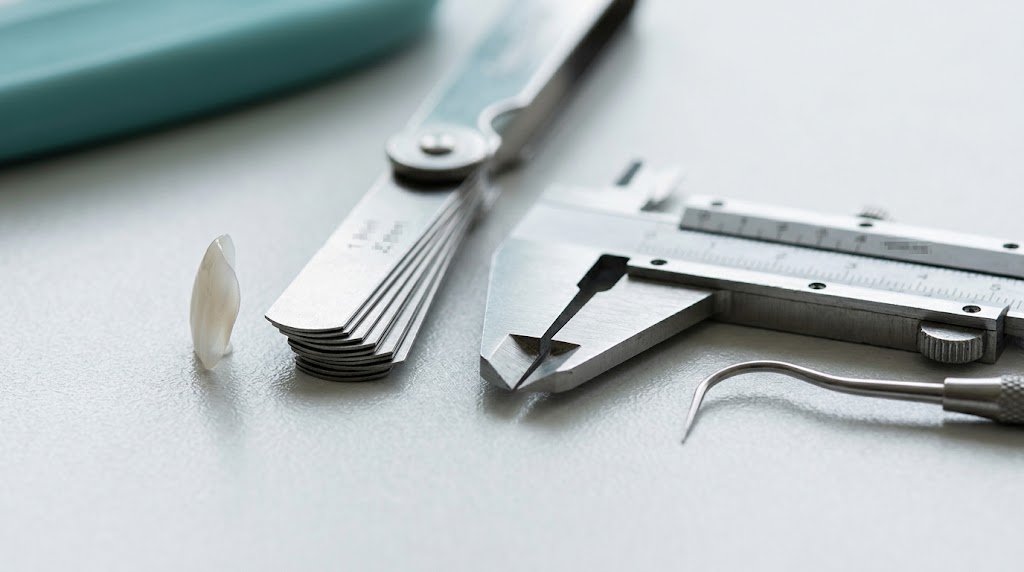
Veneers promise straight, bright teeth in two appointments. What the advertising leaves out: for a classic porcelain veneer, 0.3 to 0.7 mm of tooth enamel is ground away, and enamel does not grow back. This post sets out what veneers really cost, in tooth structure and in euros, how long they last according to the studies, when no-prep veneers are enough and when we advise against them.
Veneers have three real drawbacks: the loss of enamel is permanent, they last about 10 to 15 years and then have to be replaced, and in Germany neither the statutory health insurance (the GKV, or Krankenkasse) nor private dental top-up insurance (Zahnzusatzversicherung) usually pays anything. In the studies, 95.5% of porcelain veneers survive the first ten years; composite veneers last markedly less. No-prep veneers need no grinding, but only suit straight, fairly small and light-coloured teeth. In Germany a porcelain veneer costs 800 to 1,500 €, in Tbilisi 248 € (£213 / $287) for E.max, at a fixed price.
Table of Contents
Toggle1. Veneers: the drawbacks the advertising leaves out
The biggest drawback is that a prepared veneer is a one-way street. Once ground, the tooth needs a facing for the rest of its life, and every replacement costs tooth structure and money again. Add to that fracture, debonding, discolouration at the margin and sensitivity if the grinding reached the dentine.
The Verbraucherzentrale, Germany’s consumer advice centre (as of 5 April 2024), puts it soberly: a purely cosmetic use means the tooth structure is permanently damaged. The list in detail:
- Loss of tooth structure. Ground-away enamel does not come back. When a veneer is replaced, the tooth is usually ground again.
- Limited lifespan. 10 to 15 years is realistic, then a replacement is due.
- Fracture and debonding. Above all in the first years, mostly through grinding the teeth or biting on something hard.
- Margins. Decay can form at the junction with the tooth; with composite, the margin discolours.
- The shade is fixed. Porcelain cannot be bleached. If the neighbouring teeth darken, it shows.
- Entirely self-paid. The Krankenkasse pays nothing, and most top-up policies do not either.
2. Veneers: grinding the teeth, how much exactly?
For classic porcelain veneers, 0.3 to 0.7 mm is removed from the front of the tooth, up to about 1 mm at the incisal edge. That is less than a millimetre, but often the whole enamel layer at the neck of the tooth. No-prep veneers need 0 to 0.3 mm; composite is applied directly without grinding.
The figures come from the veneer guide at zahnkosten-rechner.de (2026), a German dental-cost comparison site; the Verbraucherzentrale speaks of “usually less than 1 mm”. As a percentage of the tooth crown: a measurement study by Edelhoff and Sorensen (J Prosthet Dent, 2002) found 3 to 30% loss of tooth structure for veneers and 63 to 72% for a full crown.
What matters is the layer rather than the millimetre. The adhesive bonds to enamel many times better than to the dentine beneath. An analysis of 672 porcelain veneers over 1 to 15 years (Etienne et al., J Esthet Restor Dent, 2025) found 96.7% survival when bonded purely to enamel and 93.9% when more than 30% of the bonding surface was dentine; the risk of loss rose 3.5-fold with exposed dentine. The enamel is thinnest at the neck of the tooth, and that is where the least is ground.
3. How long do veneers last? Lifespan according to the studies
Porcelain veneers last 10 to 15 years on average, many considerably longer. A review of 25 studies covering around 6,500 porcelain veneers calculates 95.5% survival after ten years. Composite veneers reach 88% over two to eight years in controlled studies; in practice, 5 to 8 years is the expectation.
The porcelain figures come from Alenezi et al. (J Clin Med, 2021). Counting fractures only, ten-year survival is 96.3%; debonding only, 99.2%. Two findings matter: veneers that cover the incisal edge fail less often, and lithium disilicate (E.max) performs better than feldspathic porcelain. The composite data come from the meta-analysis by Lim et al. (J Evid Based Dent Pract, 2023): 88% survival in randomised trials, with rough surfaces, shade mismatch and marginal discolouration as the most frequent problems.
| Veneer type | Grinding | Thickness | Lifespan | Price in Germany, per tooth | Price in Tbilisi, per tooth |
|---|---|---|---|---|---|
| Porcelain / E.max (prep) | 0.3–0.7 mm | 0.5–0.7 mm | 10–15 years, 95.5% at 10 years | 800–1,500 € | 248 € (£213 / $287) |
| Composite (direct) | 0 mm, surface roughened only | applied in layers | 5–8 years, 88% over 2–8 years | 300–500 € | on request |
| No-prep / Lumineers | 0–0.3 mm | approx. 0.3 mm | as porcelain, where the indication fits | 700–1,500 € | 248 € (E.max, where no-prep is possible) |
German prices according to zahnkosten-rechner.de (2026); the GZFA (13 October 2022), a German dental society, quotes 900 to 1,500 € for porcelain, 700 to 1,000 € for no-prep and 300 to 400 € for composite.
4. No-prep veneers and Lumineers: when they are enough
No-prep veneers are enough when the tooth is too small, too short or slightly discoloured and stands straight in the row. A porcelain shell about 0.3 mm thin is then bonded on without grinding. For crowded, rotated, protruding or dark teeth they are not enough, because the shell adds bulk or the shade does not cover.
Lumineers is the brand name of a US manufacturer for exactly this category, rather than a separate technique. The shells are likewise around 0.3 mm thick and, according to the GZFA, may only be fitted by certified practices.
The US dentist John Nosti describes the limits in Dentaltown (March 2012): crowding, rotated and flared teeth and heavily discoloured teeth are unsuitable for no-prep. A case report in ZWP online (28 February 2011), a German dental trade journal, names the practical risks: the shells break easily at the try-in, and without a preparation margin the edge has to taper to nothing, or a step forms at the gum. In practice, “no-prep” often still means 0.1 to 0.3 mm of grinding so that the shell does not add bulk. Ask beforehand whether the practice really means 0 mm.
5. Veneers or crowns, and what the “Turkey crown” has to do with it
A veneer is right when the tooth is healthy and only the front is to be changed. A crown is right when the tooth is heavily filled, root-treated or broken. For a crown the tooth is reduced all round by 0.5 to 1.5 mm and by 1.5 mm at the edge; for a veneer only at the front, by 0.3 to 0.7 mm.
The crown dimensions come from a review of zirconia and E.max crowns in Oral Health (November 2018). The “Turkey crown” is exactly this crown, only on healthy teeth and 16 to 20 at a time: teeth that would have needed a veneer or nothing at all are ground down to pegs. More in our post on Turkey Teeth.
| Porcelain veneer | Crown (zirconia / E.max) | “Turkey crown” | |
|---|---|---|---|
| Grinding | front 0.3–0.7 mm | all round 0.5–1.5 mm, edge 1.5 mm | as a crown, on healthy teeth |
| Loss of tooth structure | 3–30% of the crown | 63–72% | 63–72%, on 16–20 teeth |
| Risk to the nerve | low, with bonding to enamel | present, root canal possible | high, because many teeth at once |
| When it makes sense | healthy tooth, shape and shade | damaged tooth | almost never |
| Price in Germany | 800–1,500 € | around 700–1,500 € | package price in Turkey |
| Price in Tbilisi | 248 € (E.max) | 248 € (zirconia) | not offered |
6. Composite or porcelain?
Composite is the right choice for a single tooth, a chipped corner or as a trial before porcelain. Porcelain is right when a whole smile is meant to last a long time and not darken. Composite is applied directly in one appointment, costs 300 to 500 € and can be repaired, but lasts only 5 to 8 years.
Two points favour composite for a few teeth. According to the Verbraucherzentrale, it can be removed from an intact tooth without damage; porcelain cannot. And in the meta-analysis by Lim et al., directly applied composite lasted better than lab-made composite shells. The price is the surface: composite becomes rough, picks up colour from coffee and red wine and has to be polished regularly. For six or eight teeth that are meant to last 15 years, porcelain is cheaper in the end.
7. What veneers cost: Germany and Tbilisi
In Germany a porcelain veneer costs 800 to 1,500 € per tooth, composite 300 to 500 €, no-prep and Lumineers 700 to 1,500 €. In Tbilisi an E.max veneer costs 248 € (£213 / $287), a fixed price that includes planning, scan, laboratory, fitting, airport transfer and coordinator. For six front teeth you stay below a third of the German price even with flights and hotel.
The German ranges are quoted by zahnkosten-rechner.de (2026) and the Verbraucherzentrale (700 to 1,500 €, 5 April 2024). For six porcelain front teeth, zahnkosten-rechner.de reckons 4,800 to 9,000 €. Our fixed prices are on the price page; the Veneers and crowns page describes the procedure. The stay takes about ten days: scan and preparation in the first week, fitting in the second. We allow a generous 1,500 € for flights and hotel.
| Example | Germany (porcelain) | Tbilisi (E.max, fixed price) | Plus travel 1,500 € |
|---|---|---|---|
| 2 veneers | 1,600–3,000 € | 496 € (£426 / $574) | 1,996 € |
| 6 veneers | 4,800–9,000 € | 1,488 € (£1,278 / $1,722) | 2,988 € |
| 8 veneers | 6,400–12,000 € | 1,984 € (£1,704 / $2,296) | 3,484 € |
| 10 veneers | 8,000–15,000 € | 2,480 € (£2,130 / $2,870) | 3,980 € |
The table also shows when the trip is not worth it: for one or two teeth, travel costs put you in the German price range. We tell you that plainly before you book.
8. Does dental top-up insurance pay for veneers? Usually not
No, not under most policies. Purely cosmetic veneers are neither covered by the Krankenkasse nor included in standard Zahnzusatzversicherung policies. Only when the veneer is medically necessary, for instance after a broken front tooth or with enamel defects, does the Krankenkasse pay the Festzuschuss, its fixed subsidy, for a partial crown, and individual premium policies reimburse a share.
The Verbraucherzentrale and the GZFA both confirm the partial-crown exception. With top-up policies, only the contract wording counts: Check24 (checked September 2026), a German comparison portal, writes that private policies pay nothing for purely cosmetic treatment and, where medically necessary, up to 90 or 100% depending on the policy. Zahnkosten-rechner.de names one premium policy that lists veneers as dentures at 85%.
Three traps apply to every top-up policy, according to the Verbraucherzentrale (as of 23 July 2026): eight months’ waiting period, a staggered benefit cap of about 500 € in the first year, and treatments already recommended are excluded. No policy pays for treatment in Georgia.
9. How veneers last 15 years and longer
Veneers last longest if you wear a night guard, do not bite on nuts, ice or pens and go for a check-up every six months. Most fractures happen in the first years through force rather than age.
- Night guard at any suspicion of grinding; in Tbilisi it goes into the plan when the findings call for it.
- No pliers in the mouth: fingernails, threads, bottles, ice cubes.
- Gentle care: soft brush, non-abrasive toothpaste, floss daily.
- Check-up and cleaning twice a year, without ultrasonic scaling directly at the margin.
- Coffee, tea, red wine do not stain porcelain, but they do stain the bonding margin and composite.
10. When we advise against veneers
We advise against them if your teeth are healthy and straight and only need to be a shade lighter. Then whitening is the right answer rather than porcelain. We also advise against them with inflamed gums, with heavy grinding and no night guard, with badly crooked teeth without prior orthodontics, and for one or two teeth for which no trip is worthwhile.
Every plan goes to Dr Ketevan Mamulashvili, prosthodontist in Tbilisi, before booking. She checks on the scan and photos whether a veneer, no-prep, composite or no facing at all is the right answer. If an aligner or whitening at your home dentist solves the problem, the written plan says so. Veneers on crooked teeth are the most common wrong decision: the tooth is then ground by 1.5 mm rather than 0.5 mm to hide the misalignment.
Frequently asked questions
Does grinding the teeth for veneers hurt?
Usually not: at 0.3 to 0.7 mm the reduction mostly stays in the enamel, which has no nerves. Many practices work with light anaesthesia, and no-prep veneers often need none at all. Teeth become sensitive to cold and heat mainly when the grinding reached the dentine.
Can veneers be removed again?
Porcelain veneers can be removed, but the ground tooth then needs a new facing. According to the Verbraucherzentrale, composite veneers can be taken off an intact tooth without damage. The advertising promise that no-prep veneers can be removed without a trace is hard to keep in practice, because bonded porcelain cannot be separated cleanly from the enamel.
Veneer experiences: what do patients report after five years?
The most frequent reports in the studies are small chips at the incisal edge, a debonded veneer that is re-bonded, and with composite, discolouration at the margin. That matches Alenezi et al.: fracture and debonding are the main problems, mostly in the first years. We publish before-and-after cases from Tbilisi as soon as the patients have consented in writing.
How many veneers are needed for an even smile?
As many teeth as show when you laugh, usually six to eight in the upper jaw, ten with a broad smile. Fewer is possible when only one or two teeth are out of line, but then the shade has to match the neighbours exactly. Anyone who fits four veneers when eight teeth are visible will see the transition. A photo of you laughing settles this before booking.
Can I still whiten my teeth later with veneers?
No, porcelain and composite do not take bleaching agents. Only the natural teeth next to them become lighter, and then the shade no longer matches. Hence the order: whiten first, wait two weeks, then set the veneer shade. Those who do it the other way round end up with veneers that look darker than the rest.
What happens if a veneer from Tbilisi breaks in Germany?
Any German dentist can re-bond a debonded, undamaged veneer; under the GOZ, the German private dental fee schedule, that costs one appointment. A broken veneer has to be made anew, in Tbilisi for 248 € at a later visit or in Germany at the local price. What the partner clinic’s guarantee covers, and for how long, is in your written plan before you commit.
The short version
- Porcelain veneers cost 0.3 to 0.7 mm of enamel, permanently. According to the studies, 95.5% last ten years; composite markedly less. No-prep veneers are enough only for straight, fairly small and light-coloured teeth.
- A veneer removes 3 to 30% of the tooth crown, a crown 63 to 72%. The “Turkey crown” is a crown on healthy teeth, which is why we advise against it.
- In Germany 800 to 1,500 € per porcelain veneer, not covered by the Krankenkasse, and top-up policies almost never pay. In Tbilisi 248 € per E.max veneer, six teeth under 3,000 € including travel. For one or two teeth you are better off staying at home.
Send a photo of your smile or a 3D scan on WhatsApp. A coordinator replies on WhatsApp with a written treatment plan and a fixed price from a dentist in Tbilisi, free of charge and with no deposit.