

The reason a clinic 2,000 miles away can plan your implants before you have met the surgeon is digital dentistry: a CBCT scan, a 3D-printed surgical guide and a milling machine in the building. Those three things are also what separates a predictable one-stay treatment from the two-trip, freehand version. This guide explains each of them in plain English and what to ask any clinic about them.
CBCT: the scan everything else depends on
A cone-beam CT is a low-dose 3D X-ray of the jaws. It shows bone height and width to a fraction of a millimetre, the position of the nerve canal in the lower jaw and the sinus floor in the upper, and the state of every remaining root. A panoramic X-ray shows a flat silhouette; a CBCT shows the volume an implant has to sit in.
For a travelling patient the scan is the whole business case. Sent on WhatsApp from a scanner at home, it lets a surgeon in Tbilisi decide whether you need single implants, an All-on-4 arch or bone grafting before you buy a flight, and write a fixed price on that basis. Without it, the quote is a guess and the surgery day is where you find out.
Guided surgery: the implant goes where the plan says
From the CBCT, planning software positions each implant at the exact angle, depth and distance from the nerve. That plan is 3D-printed as a surgical guide, a template that fits over your teeth or gum with sleeves for the drill. On the day, the surgeon drills through the sleeves; the implant cannot go anywhere the plan did not put it.
Three consequences for you: shorter surgery (a guided All-on-4 arch takes 2–3 hours), smaller incisions and less swelling, and, most importantly for travellers, the predictability that lets a fixed temporary bridge be fitted within days. Immediate loading is only safe when the implants are where the plan says; guided placement is how that is known.
Intraoral scanning: no more impression trays
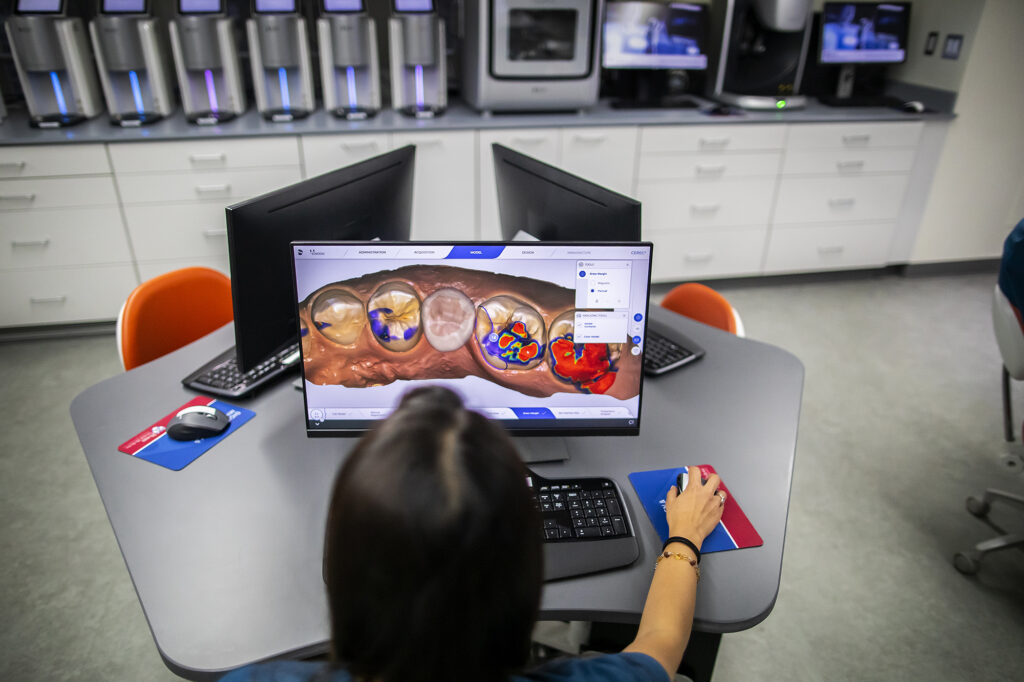
A handheld scanner records your teeth and gums as a 3D model in a few minutes. It replaces the tray of putty, is more accurate for crowns and bridges, and produces a file that goes straight to design software and the mill. For veneer and crown cases it also produces the digital mock-up you approve before any tooth is prepared, which is the single best protection against the “twenty crowns in five days” outcome described on our Turkey teeth page.
CAD/CAM: the lab is in the building
Zirconia crowns, E.max veneers and bridge frameworks are designed on screen and milled from a solid block, often in the clinic’s own lab. Milled zirconia is stronger and more consistent than hand-layered porcelain, and the turnaround is days rather than weeks. That is why a set of veneers is an 8–10-day stay and why a final All-on-4 bridge can be made without a second flight in most cases.

What it changes for a patient travelling for treatment
- Planning happens before the flight. Your CBCT, your written plan, your fixed price: all done remotely.
- Fewer and shorter visits. Scan, guide and mill in one place means one stay of 2–3 weeks for most implant plans.
- Fewer surprises. The guide places the implant where the scan said there was bone; the mill makes the crown from the scan of the implant that was actually placed.
- A record you take home. The scan, the plan and the implant passports are files; any dentist at home can open them.
Five questions to ask any clinic
- Do you take a CBCT before every implant plan, and will you plan from mine remotely?
- Is placement guided or freehand? For All-on-4 with immediate loading, guided should be the answer.
- Do you use an intraoral scanner, and will I see a mock-up before any veneer or crown preparation?
- Is the lab in-house? If not, how long does the lab take, and does that fit my stay?
- Will I receive the scan, the plan and the implant passports as files when I leave?
Our partner clinics in Tbilisi answer yes to all five; the price list includes the CBCT and the surgical guide in every implant price rather than as extras.
Frequently asked questions
Is guided implant surgery better than freehand?
For full-arch and immediate-loading cases, yes: it is more accurate and more predictable. An experienced surgeon can place a single implant freehand safely, but there is no reason to when a guide costs little and removes guesswork.
Can I get a CBCT scan at home to send in advance?
Yes. Many dental practices and imaging centres offer one for around £100–£250; ask for the DICOM files, not just a printed image, and send them on WhatsApp.
Is a CBCT scan safe?
The dose is a fraction of a medical CT and comparable to a few days of natural background radiation. It is standard of care before implants.
Does digital dentistry make treatment cheaper?
It makes it faster and more predictable; in Tbilisi it is included in the price. Its main saving for you is the second trip you do not need to take.
The short version
- CBCT before the plan, a guide during surgery, a mill for the teeth: ask about all three.
- Guided placement is what makes immediate loading and one-stay plans safe.
- Get the scan, plan and implant passports as files before you fly home.
Have a CBCT or an X-ray? Send it on WhatsApp and a surgeon plans your case from it, with a written plan and a fixed price. Free, no deposit.