
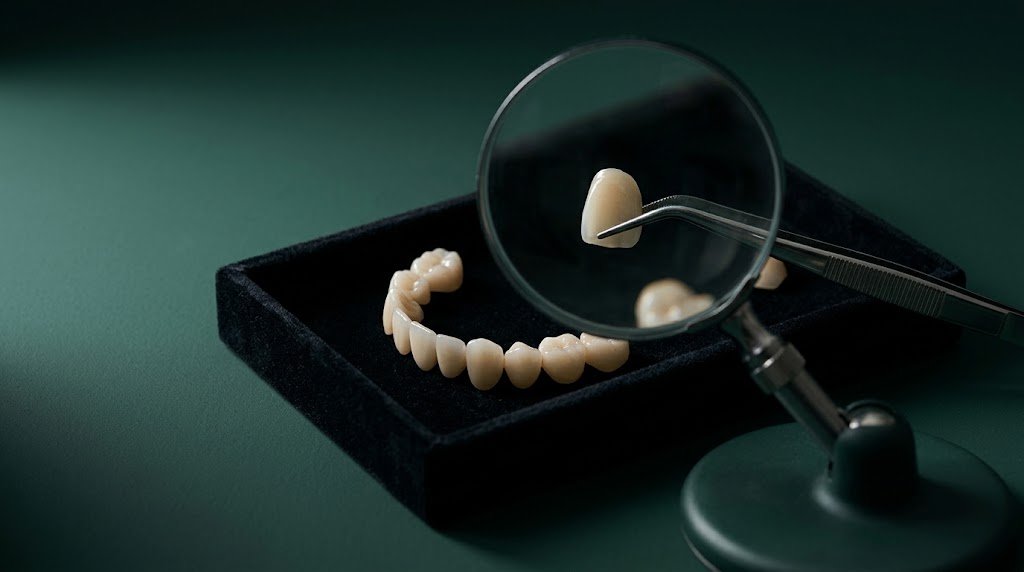
In Russia, people search for “veneers pros and cons” more often than “how much do veneers cost”, and that is the right order. A veneer sits on the tooth for 10 years or more, and once it is on, you cannot take it off and return the tooth to how it was. Below is an honest look at the pros and cons of veneers, how long they last according to the research, when no-prep is possible, veneers or crowns, and what one veneer costs in Russia and in Tbilisi.
Ceramic veneers last 10 years or more on average, but grinding the tooth down by 0.3–0.7 mm is irreversible, and every 10–15 years the veneer has to be replaced at full price. The main pros: even colour and shape in two visits, and two to four times less tooth tissue removed than for a crown. The main cons: irreversibility, sensitivity after preparation, chipping in about 4 % of veneers over 9 years, and the price. In Moscow an E.max ceramic veneer costs from 23,000 to 87,000 ₽ (roubles) per tooth; in Tbilisi it is 248 € (£213 / $287, about 23,200 ₽) including the work and materials. The rouble figures in this article are converted at the Central Bank of Russia rate for 19 October 2026, 93.72 ₽ to the euro (ppt.ru).
Table of Contents
ToggleWhat veneers are and what types there are
A veneer is a thin shell 0.2 to 1 mm thick that is bonded to the front surface of a tooth. There are three types: ceramic (most often E.max glass-ceramic), composite made from filling material, and ultra-thin “no-prep” veneers. They differ in how much the tooth is ground down, how long they last and what they cost.
A ceramic veneer is made in a laboratory from an impression or a 3D scan over two visits 7–14 days apart. A composite veneer is layered directly onto the tooth by the dentist in a single visit. Ultra-thin veneers are 0.2–0.5 mm thick against 0.3–1.0 mm for conventional ones, according to a review in Cureus (2023).
| Type of veneer | Preparation | Lifespan | Price per tooth, Russia | Price per tooth, Tbilisi |
|---|---|---|---|---|
| Ceramic (E.max, glass-ceramic) | 0.3–0.7 mm, within the enamel | 10–15 years, 94 % intact after 9 years | 23,000–87,000 ₽ | 248 € (£213 / $287, about 23,200 ₽) |
| Composite | 0–0.5 mm | 5–7 years, 88 % intact after 2–8 years | 7,000–15,000 ₽ | On request, not in our price list |
| No-prep (ultra-thin ceramic) | 0–0.3 mm, often polishing only | Little data, 9 years with no losses in one study | 25,000–45,000 ₽ | 248 € (£213 / $287), if the case is suitable |
Pros of veneers
The main advantage of veneers is that they change the colour and shape of the front teeth in two visits and remove two to four times less tooth tissue than a crown. For dark teeth, chips and gaps, this is the gentlest way to get an even smile.
- The colour does not darken from coffee and tea; ceramic does not absorb stains.
- Only the front is prepared. By Edelhoff and Sorensen’s measurements, a veneer takes 3–30 % of the tooth’s crown structure, a crown 63–72 % (review in PMC).
- The tooth stays alive. The nerve is not removed for a veneer, unlike with “Turkey teeth”, which we wrote about on the page on crowns on healthy teeth.
Cons of veneers
The main drawback is that a prepared tooth cannot be restored, and the veneer will have to be redone every 10–15 years at full price. Advertising for a “Hollywood smile in a week” says nothing about this lifelong commitment.
- Irreversibility. Even 0.3 mm of removed enamel will not grow back. Once a veneer is taken off, the tooth has to be covered with a new veneer or a crown.
- Sensitivity. After preparation, the tooth can react to cold for several weeks.
- Chipping and debonding. Over 9 years about 4 % of veneers chip, 2 % debond, and a further 2 % of teeth need root canal treatment (Morimoto et al., 2016).
- A night guard. With bruxism it has to be worn every night, otherwise the ceramic chips.
How long veneers last: what the research says
According to a meta-analysis of 13 clinical studies, 89 % of ceramic veneers are still in place after 9 years, with glass-ceramic (E.max) at 94 % and older feldspathic porcelain at 87 % (Morimoto et al., Int J Prosthodont, 2016). Composite veneers hold up less well: 88 % after 2–8 years.
The composite figure comes from a 2023 meta-analysis: 88 % in randomised trials with 24–97 months of follow-up, direct veneers lasted longer than laboratory-made ones, and the common complaints were roughness, colour and darkening at the margin (Lim et al., J Evid Based Dent Pract, 2023).
“Survival” means the veneer is still on the tooth, not that it looks like new. In practice ceramic lasts 10–15 years and composite 5–7 years. Preparation deeper than the enamel, bruxism without a guard and a habit of biting hard things all shorten that.
No-prep veneers: who they suit
No-prep veneers suit a narrow range of cases: small or slightly “set back” teeth, gaps, worn edges, and a wish to lighten the colour by no more than one or two shades. If the teeth are dark, large or crooked, no-prep gives a “bulky” smile with an overhanging margin.
An ultra-thin veneer 0.2–0.5 mm thick adds that volume to a tooth that already sits in line, so the margin at the gum thickens and collects plaque. In practice “no-prep” often means polishing 0.1–0.3 mm off the enamel.
There is little data on these veneers. In one study, 102 no-prep veneers showed no losses over 9 years, but it had only 35 patients, and the groups were recruited in different years (Smielak et al., Clin Oral Investig, 2022). A 2023 review states plainly that there is almost no clinical work on true no-prep veneers (Cureus, 2023). “Lumineers” is a trade name, not a technique.
Veneers or crowns
If the tooth is alive, with no large fillings or cracks, a veneer is better than a crown because it keeps 70–97 % of the tooth’s crown structure. A crown is needed when little tooth is left: a large filling, past root canal treatment, a crack, heavy wear, or no enamel to bond to.
| Criterion | Veneer | Crown |
|---|---|---|
| Preparation | Front surface, 0.3–0.7 mm | All sides, 1–2 mm |
| Tooth tissue removed | 3–30 % | 63–72 % |
| Nerve | Kept | Kept, but the risk of root canal treatment is higher |
| When it suits | Colour, shape, chips, gaps on a living tooth | Large fillings, root canals, cracks, wear |
| Lifespan | 10–15 years | 10–15 years and longer |
| Price in Moscow per tooth | 23,000–87,000 ₽ | Comparable; zirconia is often dearer |
| Price in Tbilisi per tooth | 248 € (£213 / $287) | 248 € (zirconia) |
Crowns on all 20 front teeth “to be safe” are excessive; that is how “Turkey teeth” happen. There is a detailed comparison on the page veneers and crowns.
Composite or ceramic veneers
Composite suits when you need to cover 1–2 teeth, stay within a budget, or have a temporary option for a few years. Ceramic suits when there are 6 or more veneers, you need a stable colour, and a lifespan of 10 years or longer. Composite is cheaper and can be repaired directly in the mouth.
Composite darkens from coffee, tea and smoking, needs polishing once a year, and replacing after 5–7 years. E.max ceramic does not change colour, but when it chips it is more often replaced entirely. The price difference in Moscow is roughly threefold: 7,000–15,000 ₽ against 23,000–87,000 ₽ per tooth.
Veneers: price per tooth in Russia and in Tbilisi
An E.max ceramic veneer for one tooth costs from 23,000 to 87,000 ₽ in Moscow according to published price lists on 19 October 2026, with a typical price of 35,000–55,000 ₽. In Tbilisi the same veneer costs 248 € (£213 / $287), about 23,200 ₽, including the work and materials, and the price is fixed in writing before you travel.
The aggregator Startsmile (a Russian dental price comparison site; Moscow, promotions on the page until 31.10.2026): composite veneer 7,000–10,000 ₽, E.max from 23,000 ₽, Lumineers about 25,000 ₽, and 12 clinics in its table with a “from” price of 27,000 ₽. Bobrov Clinic (a Moscow clinic): composite 11,500 ₽, E.max 35,000 ₽. Pro Ulybki (“About Smiles”, a Moscow clinic): E.max 42,500 ₽ in category “B” and 53,140 ₽ in category “A”, with a try-in and a temporary veneer. Doctor Levin (a Moscow clinic, promotion until 31 October): E.max 76,000 and 87,000 ₽. The clinic pages do not show when their price lists were last updated.
A worked example, with illustrative figures. Eight E.max veneers in Moscow at 42,500 ₽ each come to 340,000 ₽; in Tbilisi 1,984 € (£1,704 / $2,296), about 186,000 ₽, plus flights and 10 days of accommodation. For one or two veneers the trip makes no sense; it is more honest to have them done at home. The full price list is on the prices page.
Who should not have veneers
Veneers are not placed with untreated decay or inflamed gums, with bruxism without a guard, with large fillings on the front teeth, with an edge-to-edge bite and heavy wear, or where enamel is lacking after acid erosion. In each case there is another solution, usually cheaper.
| Situation | Why a veneer does not suit | What will be offered instead |
|---|---|---|
| Decay, periodontitis, bleeding gums | The veneer margin would sit on inflamed gum, and the adhesive does not hold on a wet tooth | Treatment and hygiene first, veneers after 1–2 months |
| Bruxism (teeth grinding) | Ceramic chips under the load | Veneers only with a night guard, or zirconia crowns |
| Large filling or root-treated tooth | Too little enamel to bond to, the tooth is brittle | Crown |
| Edge-to-edge bite, heavy wear | The veneer margin takes the impact when the teeth close | Orthodontics first, or crowns that cover the edge |
| Acid erosion, severe fluorosis | No enamel for adhesion | Crowns or treating the cause |
| Crooked teeth, crowding | Deep preparation into the dentine would be needed | Aligners or braces, then veneers if wanted |
| Under 18 | Teeth and gums are still growing | Composite as a temporary solution |
The enamel on the front teeth is only 0.24–0.35 mm thick at the gum and about 1.2 mm at the incisal edge (J Dent Tehran, 2014), so preparation at the gum should be about 0.4 mm and up to 0.7 mm on the main surface (British Dental Journal, 2002). If a dentist promises to “straighten” a crooked tooth with a veneer, ask whether the preparation will stay within the enamel.
How to look after veneers
Caring for veneers is no different from caring for your own teeth, apart from three rules: do not bite hard things with the front teeth, wear a guard if you grind, and come for a check-up once a year. These decide whether a veneer lasts 7 years or 15.
- Non-abrasive toothpaste. Whitening paste with coarse particles scratches composite and the edge of ceramic.
- Floss or interdental brushes every day, otherwise plaque on the veneer margin turns into a dark line.
- Do not open packaging with your teeth, do not bite nuts, ice or seeds. This is the most common cause of chipping.
Veneer reviews: how to tell the real ones
A real veneer review is written a year or more later, names the number of teeth, the material, the amount paid and what went wrong. A review the day after bonding says nothing about the result, because chips, dark lines and sensitivity arrive after 1–5 years.
“Six E.max, 300,000 roubles, one chip after two years, redone under warranty” sounds more credible than “great, recommend”. We do not publish our own reviews or success statistics, because we cannot verify them.
Veneers in Tbilisi: how it works and when not to go
In Tbilisi, E.max veneers cost 248 € (£213 / $287) per tooth, the whole process takes about 10 days and two clinic visits, and you receive the plan and the price in writing before you buy tickets. The trip makes sense from six veneers upwards.
You send a photo of your smile or a 3D scan on WhatsApp. A prosthodontist at the partner clinic draws up a plan, which is checked by Dr Ketevan Mamulashvili, a prosthodontist and our medical reviewer. At the first visit you have a hygiene session, a try-in of the shape, preparation and temporary veneers; 7–10 days later the permanent ones are bonded. A coordinator is present at every appointment.
When not to go: one or two veneers, untreated decay or inflamed gums, crooked teeth that need straightening first, and a plan with 20 crowns instead of 6 veneers. We are a coordination service, not a clinic, and we do not carry out treatment ourselves.
Frequently asked questions
Does getting veneers hurt?
Preparation is done under local anaesthetic, and there is no pain during the procedure. Once the anaesthetic wears off, the tooth may react to cold for 1–3 weeks while the temporary veneer is in place. After the permanent veneer is bonded, the sensitivity usually goes. If pain lasts longer than a month or an aching pain appears, the tooth needs to be checked, as the nerve may be inflamed.
Can veneers be removed to get your own teeth back?
A veneer can be removed; the tooth cannot be returned to its previous state. Removed enamel does not grow back, and after the veneer comes off the tooth will be rough, sensitive and darker. A new veneer or a crown goes in its place. The exception is no-prep veneers: after them the tooth stays as it was, but they suit only a few people.
Do teeth decay under veneers?
A veneer in itself does not damage the tooth; the ceramic is sealed to the enamel. Problems start at the margin: if plaque collects there, decay develops under the veneer. According to the 2016 meta-analysis, secondary decay occurred in about 1 % of veneers over 9 years and nerve inflammation in about 2 %. Daily flossing and a yearly check-up reduce this risk.
How many veneers do you need?
As many as show when you smile. For most people that is 6–8 upper teeth, for some 10; the lower teeth are often left alone. A single veneer is placed on a chipped or dark tooth, and then the dentist’s main task is to match the colour of the neighbours. The more veneers, the more even the colour, but the more healthy enamel is lost.
Veneers or whitening?
If your teeth are straight and only the colour bothers you, whitening comes first. It is reversible, costs several times less and needs no preparation. Veneers are needed when whitening does not shift the colour (tetracycline teeth, fluorosis, a tooth after trauma) or when, besides the colour, the shape needs changing, or chips and gaps need closing. Many clinics whiten first and then place 1–2 veneers.
Can you have veneers with bruxism?
You can, but only with a night guard and an honest conversation about the risks. With grinding, the load on the ceramic is several times higher, and a chip becomes a matter of time. The dentist may suggest veneers in a stronger glass-ceramic, covering the incisal edge, or zirconia crowns on the most heavily loaded teeth. Without a guard the warranty usually does not apply.
The short version
- Ceramic veneers last 10–15 years, 94 % of E.max are intact after 9 years, composite 5–7 years. The 0.3–0.7 mm preparation is irreversible.
- A veneer suits a living tooth without large fillings; a crown is needed when little tooth is left. No-prep works for only a small group of patients.
- One E.max veneer costs 23,000–87,000 ₽ in Moscow and 248 € (£213 / $287, about 23,200 ₽) in Tbilisi. The trip makes sense from six veneers upwards.
Send a photo of your smile or a 3D scan on WhatsApp, and a prosthodontist in Tbilisi will reply with a written plan and a fixed price for each tooth. Free, with no deposit. A coordinator replies on WhatsApp in English, Russian or Hebrew.