
If you have been told “you do not have enough bone for implants”, your next search probably turned up an advert for basal dental implants: fixed teeth within three days, no bone graft, no months of waiting. Exactly what you wanted to hear. We plan implant treatment in Tbilisi, and we do not offer basal implants. Here we explain what they are, what the professional literature says about them, what they cost in Israel, and what we plan instead when bone is missing.
A basal (bicortical) implant is a long, thin implant anchored in the hard cortical bone of the jaw and loaded with a cemented bridge within days. The reviews up to 2026 found only studies without a control group, with an average follow-up of about three years, and found no sufficient evidence to prefer it over a conventional implant. If a basal implant fails, it is hard to remove and the inflammation around it is hard to treat. In Israel one arch on basal implants is priced at ₪35,000–58,000, a full mouth at ₪58,000–95,000. In Tbilisi we plan a conventional All-on-4 with tilted implants instead, at ₪13,600 (about £3,340 / $4,500) per arch, and if bone is needed, we graft and wait.
Table of Contents
ToggleWhat exactly is a basal implant?
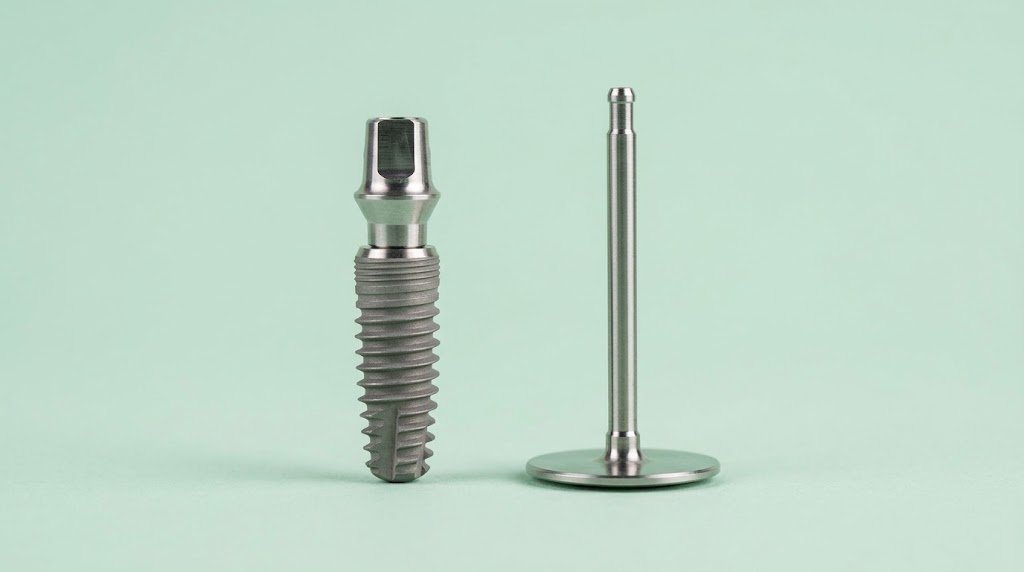
A basal implant, also called a bicortical implant, is an implant anchored in the basal layer of the jaw, the dense bone that remains even after the bone around the tooth roots has resorbed. A conventional implant is screwed into the spongy bone where the teeth used to sit and fuses with it over several months.
There are two families. Disc implants (BOI) are inserted from the side through a cut in the bone and rest on a horizontal disc. Screw-type basal implants (KOS, BCS and similar) are long, thin screws with a smooth surface, inserted through the gum down to the hard bone of the nasal floor, the sinus or the edge of the jaw. In both families the idea is the same: not to wait for the bone to fuse with the implant, but to obtain immediate mechanical hold and, within 72 hours, to fit a cemented bridge over all the implants that splints them to one another.
Who markets basal implants, and why to you in particular
Basal implants are almost always marketed to people who have heard “no bone” at another clinic. The message is constant: no bone graft, no sinus lift, no six months of waiting, fixed teeth within three to seven days. The message is built around the fears of someone who has already had an implant fail.
This is how it looks in Israel. iDen (National Dental Centre), an Israeli chain of dental clinics, writes about a temporary restoration “within 72 hours”, complete treatment in 3–7 days against 6–12 months with the conventional method, and 94–97% success after five years. Perfecshen, an Israeli clinic, promises fixed teeth “after only a few days” and itself notes that few dentists in Israel specialise in the method. Most basal implants are made by small companies that both train the dentists and publish the studies. That obliges you to read the evidence with open eyes.
What the professional literature actually says
The literature on basal implants is thin, short and mostly uncontrolled. A literature review published in 2024 in The Open Dentistry Journal (Habash and colleagues) found only 17 studies: 6 clinical studies and 11 case reports, all at evidence level V, the lowest, without a single randomised controlled trial. The authors’ conclusion: there is not enough evidence to recommend basal implants over conventional implants, and the conventional implant should remain the standard.
A more recent narrative review, published in March 2026 in the European Journal of Dental and Oral Health, gathered 38 papers on screw-type basal implants and found survival of 87–100%, 98.9% on average. That sounds excellent, until you read the average follow-up time: 34.6 months. Here too the authors conclude that the advantage over a conventional implant remains unclear. For comparison, a systematic review of 25 studies on All-on-4 (Gaonkar and colleagues, 2021) found implant survival of 94–98% over 6–11 years, with no difference between straight and tilted implants.
On complications, the 2024 review cites a retrospective study with a median follow-up of 7 years that reported 15% biological and 56% mechanical complications in bicortically anchored implants, as well as reports of fractures of basal implants. It also notes that patients with basal implants reported more pain than patients with conventional implants.
| Measure | Basal implant | Conventional implant (delayed loading) | All-on-4 with tilted implants |
|---|---|---|---|
| Evidence base | 17 uncontrolled studies (2024); 38 papers, average follow-up 34.6 months (2026) | Decades of controlled studies and Cochrane reviews | 25 studies, 94–98% survival at 6–11 years (2021) |
| If the implant fails | Hard to remove; inflammation around the implant is not accessible for treatment | Can be removed, the inflammation treated and a new implant placed | As a conventional implant |
| Bone | No bone graft; average marginal bone loss 1.15 mm in the first year | Sufficient bone required, otherwise a bone graft and 4–6 months of healing | Tilted posterior implants bypass the sinus and the nerve; bone loss 1.3 mm at 12–60 months |
| The bridge | Cemented, usually metal-acrylic or metal-ceramic | Screw-retained or cemented crown or bridge, can be taken apart | Screw-retained zirconia bridge, can be removed for maintenance |
| Price in Israel | ₪35,000–58,000 per arch, ₪58,000–95,000 for a full mouth | ₪2,000–6,000 per single implant without crown | ₪35,000–70,000 per arch |
| Price in Tbilisi | Not offered | ₪2,200 (about £540 / $730, NTA®) or ₪4,400 (about £1,080 / $1,450, Straumann®) including crown | ₪13,600 (£3,340 / $4,500) per arch including the fixed bridge |
Basal dental implants: the downsides that do not appear in the advert
The main downside is what happens when a basal implant fails, rather than any certainty that it will. A failed conventional implant is removed, the site cleaned, and sometimes a new implant placed after healing. A basal implant is anchored in hard cortical bone, sometimes close to the sinus or the nerve canal, and the 2024 review describes it as non-retrievable. Inflammation around the implant is likewise described there as inaccessible for treatment, unlike a conventional implant, where the superstructure is taken off and the site cleaned.
- Short, weak evidence. There is no controlled study, the average follow-up is under three years, and some of the studies were written by the people who make the system.
- A smooth surface without full integration. The Wedent clinic, an Israeli practice that has chosen not to offer the method, explains that the polished surface does not let bone fuse with the implant as it does with a rough-surfaced implant. Stability rests on the bridge that joins the implants.
- A cemented bridge. Cement remnants under the bridge are a recognised cause of inflammation around implants, and the bridge cannot be taken apart for cleaning or repair without cutting it.
- High dependence on the surgeon. Even the iDen site, which markets the method, lists a steep learning curve, few experienced dentists, a higher infection risk, a risk of nerve injury and aesthetic limits in the front of the mouth.
- Ongoing bone loss. Even the sympathetic 2026 review reports average marginal bone loss of 1.15 mm in the first year, precisely the resource you are short of.
Is there an official position from a professional body?
We found no formal position paper from the Israel Dental Association, the ITI or the EAO on basal implants, neither for nor against. What exists is the literature we have described, and silence: the international implant guidelines are built around implants that fuse with bone, and basal implants are not part of them.
What can be said: when a clinic advertises “97% success” for basal implants, ask which study that is based on, how many years the follow-up lasted, and who funded it. The honest answers will usually be: one retrospective study, two to five years, and the manufacturer.
What basal dental implants cost in Israel
According to four Israeli price lists we checked on 19 October 2026, a single basal implant costs ₪2,000–5,600, one arch ₪35,000–58,000, and a full mouth ₪58,000–100,000. The method is not cheaper than conventional implants. The saving you are promised is on the bone graft, which according to iDen’s price list costs ₪2,500–5,000 in Israel, with a sinus lift at ₪4,000–8,000.
| Source (date on page) | Single basal implant | One arch | Full mouth |
|---|---|---|---|
| iDen (updated April 2026) | ₪3,500–4,800 monoblock, ₪4,200–5,600 BOI/KOS, including crown | “basal All-on-4” ₪35,000–45,000, “basal All-on-6” ₪45,000–58,000 | Not stated |
| DentalGuide, an Israeli dental price guide (updated March 2026) | ₪2,000–4,500 | Not stated | ₪60,000–90,000 |
| Perfecshen (no publication date) | ₪2,500–5,000 | Not stated | ₪58,000–95,000 |
| Wedent (undated) | ₪2,300–4,000 | ₪70,000–100,000 | Not stated |
Compare with the conventional alternative. According to the price lists of DentalGuide, Perfecshen and iDen, which we checked again today, one arch on a conventional All-on-4 costs ₪35,000–70,000 in Israel. In Tbilisi the fixed price is ₪13,600 (£3,340 / $4,500) per arch, and two arches ₪27,200 (about £6,680 / $9,000). Even after adding about ₪5,000 for flights and three weeks in a hotel, a full mouth on All-on-4 in Tbilisi comes to about ₪32,200, against ₪58,000–100,000 for a full mouth on basal implants in Israel.
| Treatment, one arch | Israel | Tbilisi (fixed price) |
|---|---|---|
| Conventional All-on-4, fixed bridge included | ₪35,000–70,000 | ₪13,600 (£3,340 / $4,500) |
| Conventional All-on-6 | ₪45,000–75,000 | ₪17,500 (about £4,300 / $5,800) |
| Arch on basal implants | ₪35,000–58,000 (iDen), up to ₪100,000 (Wedent) | Not offered |
| Bone graft / sinus lift | ₪2,500–5,000 / ₪4,000–8,000 | Priced in writing before you fly |
Dental implants: the risks that apply to every implant
Any implant, basal or conventional, can fail, become infected or injure a nerve. The difference is what can be done afterwards. With a conventional implant the main risks are failure to integrate in the first months, inflammation around the implant in the years that follow, and injury to the nerve or the sinus if the planning was not precise.
Most of these risks shrink with a CBCT scan before surgery, a written plan that matches the number and length of the implants to the bone actually present, and avoiding surgery in heavy smokers or people whose diabetes is not controlled. What no method reduces is maintenance: professional cleaning twice a year, and a bridge that can be taken apart for it. A screw-retained bridge on conventional implants comes off; a cemented bridge on basal implants does not.
What to do when there really is no bone: the conventional alternative
When bone is missing there are three established routes, and all of them rest on conventional implants. The first and most common is All-on-4 with posterior implants tilted at 30–45 degrees, which bypass the sinus above and the nerve below. In most cases this avoids the bone graft, which is exactly the promise the basal implant sells, only with 6–11 years of follow-up behind it.
The second is a bone graft or sinus lift, 4–6 months of healing, and then conventional implants. Slower, but this way bone is rebuilt rather than bypassed. The third, for extreme cases of a severely resorbed upper jaw, is zygomatic implants anchored in the cheekbone. An umbrella review from 2020 found survival of 95–100% for them, with sinusitis as the most common complication. A major operation, in the hands of an oral and maxillofacial surgeon only, for a small minority of patients, but documented far better than any basal method.
What we do in Tbilisi, and why not basal
We do not offer basal implants because we will not offer a treatment we cannot repair if it fails. Our partner clinics work with Straumann® and Bredent®, and in the budget packages with B&B Dental® and NTA®, systems in which a failed implant can be removed and replaced, and a broken bridge can be taken apart.
This is how it works when you write to us “I was told I have no bone”. You send a CBCT scan on WhatsApp, or have it taken with us in Tbilisi, where it is included in the price. Dr Ketevan Mamulashvili, a prosthodontist, goes over the scan with the surgeon and returns a written plan: All-on-4 with tilted implants if the bone at the front of the jaw is sufficient, All-on-6 in soft bone, or a bone graft and a wait if there is no alternative. The fixed price for a full arch is ₪13,600 (£3,340 / $4,500) and includes the CBCT, a surgical guide, implants and abutments, surgery under local anaesthetic, the fixed bridge, airport transfer, a coordinator at every appointment and an implant passport. Bone grafting, sinus lift and sedation are priced in writing before you fly. The final bridge is fitted after the implants have healed. Your written plan states whether that happens during your stay or on a short second visit, and what is included. A description of the treatment stages, dental implants before and after, is on the full-arch page.
And sometimes the honest answer is “do not fly”. A single implant almost never justifies the trip, and for someone whose bone requires two long stages, it is sometimes better to have the implants placed in Israel. We will tell you so in writing.
Questions to ask a clinic offering you basal implants
Do not argue about the method; ask for numbers and documents. A serious clinic will answer without evasion and will write the answers into the quote.
- Which manufacturer and which implant model exactly, and are they registered with the Israeli Ministry of Health?
- How many basal arches has the dentist personally completed, and how many of them have been followed for more than five years?
- What happens if an implant fails after a year: who removes it, what does it cost, and what is left of the bone afterwards?
- Is the bridge cemented or screw-retained? How is it cleaned underneath, and what happens if one tooth in the bridge breaks?
- Does the price include the CBCT, the fixed bridge, anaesthesia, and repairs in the first two years?
- Have you checked whether All-on-4 with tilted implants is possible for me, and if not, why not?
Frequently asked questions
Are basal implants really suitable for someone with no bone?
They are designed for that situation, and short-term studies show that they stay in place in the first years. The problem is that the evidence ends after about three years on average, and a failed implant is hard to remove. In most “no bone” cases, All-on-4 with tilted implants, or a bone graft and conventional implants, is a far better documented solution.
How much do basal dental implants cost in Israel?
According to the iDen, DentalGuide, Perfecshen and Wedent price lists we checked in October 2026: a single implant ₪2,000–5,600, one arch ₪35,000–58,000, a full mouth ₪58,000–100,000. That is similar to the price of a conventional All-on-4 in Israel, ₪35,000–70,000 per arch. In Tbilisi a conventional All-on-4 costs ₪13,600 (£3,340 / $4,500) per arch including the fixed bridge.
Can a basal implant be removed if it fails?
It can, but it is a harder operation than removing a conventional implant. The implant is anchored in hard cortical bone, sometimes next to the sinus or the nerve, and the 2024 review describes it as non-retrievable. With a conventional implant, a failed implant is removed in a short procedure, and after healing a new one can usually be placed.
Zirconia crowns: what are the downsides, and what goes on a basal bridge?
Zirconia is a hard, strong material. Its downsides: possible wear of the opposing teeth if the bridge is not well polished, difficulty repairing a small chip in the mouth, and a more opaque look in older generations of the material. Basal bridges are usually cemented metal-acrylic or metal-ceramic, and the main problem there is the cement that cannot be undone, rather than the material.
Are basal implants more painful?
The 2024 review in the Open Dentistry Journal notes that patients with basal implants reported higher pain levels than patients with conventional implants, whether immediately or delayed loaded. That is a figure from a single study, but it makes sense: the implant enters hard, dense bone, and usually 8–12 implants are placed per arch instead of 4–6.
If I have flown to Tbilisi and do not have enough bone for All-on-4, what happens?
That does not happen as a surprise, because the plan is built on a CBCT scan before you book a flight. If the scan shows that even tilted implants will not hold, the written plan will propose All-on-6, a bone graft and a wait, or in rare cases zygomatic implants, with a price for each option. If there is no safe solution, we say so in advance and you do not fly.
The short version
- A basal implant is anchored in hard bone and loaded with a cemented bridge within days. The literature on it: 17 studies without a control group, an average follow-up of under three years, and a failed implant that is hard to remove.
- In Israel the method costs ₪35,000–58,000 per arch and ₪58,000–100,000 for a full mouth, no less than a conventional All-on-4. The only saving is on the bone graft, which costs ₪2,500–8,000.
- In Tbilisi we do not offer basal implants. Instead: All-on-4 with tilted implants at ₪13,600 (£3,340 / $4,500) per arch, All-on-6 at ₪17,500 (£4,300 / $5,800), or a bone graft and a wait, all at a fixed price in writing before you fly.
Send us a CBCT scan or a panoramic X-ray on WhatsApp and you will receive a written plan with a fixed price, including an honest answer on whether your bone is enough for All-on-4. A coordinator replies on WhatsApp. Free, no deposit.